


Page 22 - Azerbaijan State University of Economics
P. 22
A.I.Bayramov:Economic time from methodological point of view: anatomy of conceptual  vision


               relations and stagnation. As we have mentioned before the economic time is “manageable” and

               “applicable  for  regulation”.  Therefore  notwithstanding  the  subjective  reasons  of  the
               “acceleration” (political, ideology and interests), it brings about nothing more than distortions.

               The speed of the economic time is in negative correlation with the “weight” of the purpose of the
               current society. It is not allowed to “load” the economic time more that it can carry out!

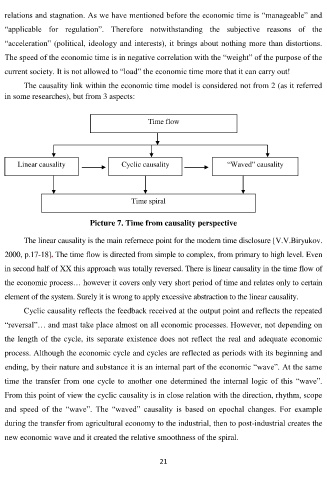
                     The causality link within the economic time model is considered not from 2 (as it referred
               in some researches), but from 3 aspects:


                                                          Time flow


                   Linear causality               Cyclic causality               “Waved” causality


                                                     Time spiral

                                         Picture 7. Time from causality perspective

                     The linear causality is the main refernece point for the modern time disclosure [V.V.Biryukov.

               2000, p.17-18]. The time flow is directed from simple to complex, from primary to high level. Even

               in second half of XX this approach was totally reversed. There is linear causality in the time flow of
               the economic process… however it covers only very short period of time and relates only to certain

               element of the system. Surely it is wrong to apply excessive abstraction to the linear causality.
                     Cyclic causality reflects the feedback received at the output point and reflects the repeated

               “reversal”… and mast take place almost on all economic processes. However, not depending on

               the length of the cycle, its separate existence does not reflect the real and adequate economic
               process. Although the economic cycle and cycles are reflected as periods with its beginning and

               ending, by their nature and substance it is an internal part of the economic “wave”. At the same
               time the transfer from  one cycle to  another one determined the internal  logic of this  “wave”.

               From this point of view the cyclic causality is in close relation with the direction, rhythm, scope

               and  speed  of  the  “wave”.  The  “waved”  causality  is  based  on  epochal  changes.  For  example
               during the transfer from agricultural economy to the industrial, then to post-industrial creates the

               new economic wave and it created the relative smoothness of the spiral.


                                                             21

