


Page 102 - Azerbaijan State University of Economics
P. 102
Bryan Davis: State owned enterprises: Chinese fdi in Canada via the lenses of perceptual,  political,
                                                                                      economic and social considerations


                            France                17.2    16.7   17.6   17.3   15.3           -11%
                            Japan                 13.6    12.4   14.5   12.6   12.8            -6%
                            China                  4.2    5.7    12.2   11.7   10.9           160%
                       All other countries        58.7    73.7   75.9    78    83.3            42%

                     Foreign Direct Investment: from China


                     In recent years, China’s SOEs have started to extend their reach to global markets to secure access

               to raw materials, resources and new technologies. With its ever-growing appetite for energy and with over

               $3.2 trillion in foreign exchange reserves, China has an abundance of excess cash on hand to invest in

               invest in strategic sectors.


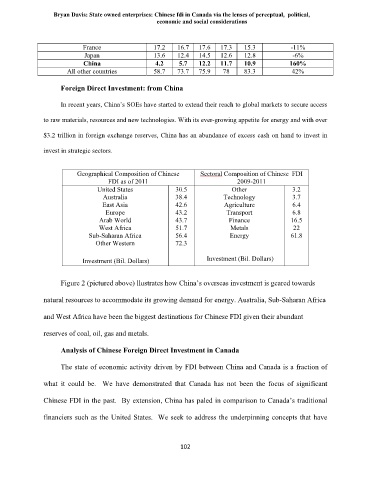
                          Geographical Composition of Chinese          Sectoral Composition of Chinese  FDI

                                    FDI as of 2011                           2009-2011
                                United States            30.5              Other               3.2
                                  Australia              38.4            Technology            3.7
                                  East Asia              42.6            Agriculture           6.4
                                   Europe                43.2             Transport            6.8
                                 Arab World              43.7             Finance             16.5
                                 West Africa             51.7              Metals              22
                              Sub-Saharan Africa         56.4              Energy             61.8
                                Other Western            72.3

                            Investment (Bil. Dollars)               Investment (Bil. Dollars)


                     Figure 2 (pictured above) llustrates how China’s overseas investment is geared towards


               natural resources to accommodate its growing demand for energy. Australia, Sub-Saharan Africa

               and West Africa have been the biggest destinations for Chinese FDI given their abundant

               reserves of coal, oil, gas and metals.


                     Analysis of Chinese Foreign Direct Investment in Canada

                     The state of economic activity driven by FDI between China and Canada is a fraction of

               what  it could be.   We  have demonstrated  that  Canada has not been the  focus  of  significant


               Chinese FDI in the past.  By extension, China has paled in comparison to Canada’s traditional

               financiers such as the United States.  We seek to address the underpinning concepts that have


                                                           102

