


Page 94 - Azerbaijan State University of Economics
P. 94
THE JOURNAL OF ECONOMIC SCIENCES: THEORY AND  PRACTICE, V.71,  # 1, 2014,  pp. 80-98


                     Service sector does not follow the same trend  as  resource sector (Fig.7).  Generally,


               services  sector contributes  from  35 to 50% of country’s GDP.  So,  there  is  no opportunity to

               clearly detect the following symptom: 3) Growth of the services sector.

                     Analysis of Venezuelan currency appreciation is rather complicated. First of all, there was a


               strong devaluation in 1983. Second, there was a money reform in 2007 when 1000 Bolivars were

               exchanged to 1 Bolivar Fuerte (VEB). And third, since 2003 the adoption of exchange control has

               been established with the fixed VEB-USD exchange rate which changed several times and which


               is highly deviating from the black market exchange rate in the country. In order to make a review

               of Venezuelan currency exchange rate, much more sophisticated analysis is required.


                     So, the symptom: 5) appreciation of local currency in the present survey cannot be clearly

               identified.

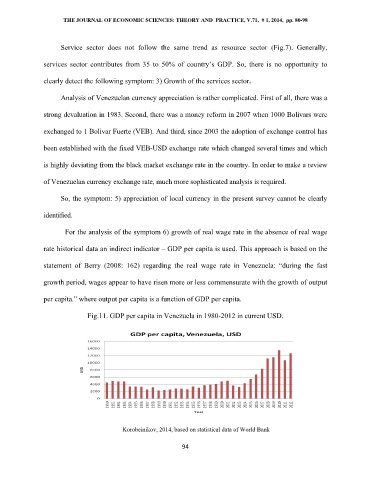
                      For the analysis of the symptom 6) growth of real wage rate in the absence of real wage


               rate historical data an indirect indicator – GDP per capita is used. This approach is based on the

               statement of Berry (2008:  162)  regarding the  real wage rate in  Venezuela: “during the fast

               growth period, wages appear to have risen more or less commensurate with the growth of output


               per capita.” where output per capita is a function of GDP per capita.

                             Fig.11. GDP per capita in Venezuela in 1980-2012 in current USD.


                                        Korobeinikov, 2014, based on statistical data of World Bank

                                                           94

