


Page 22 - Azerbaijan State University of Economics
P. 22
THE JOURNAL OF ECONOMIC SCIENCES: THEORY AND PRACTICE, V.72,  # 2, 2015, pp. 4-23


                      Mineral and Quarrying Goods              3.96   -0.54**       0.29     1,0
                     Note: F-stat is the F-statistic for the bounds-test of cointegration. ECT is the error correction
                     term. R-squared is the coefficient of determination from the error correction regression. Lag
                     order  is  the  optimal  lag  length  according  to  the  Schwarz-Bayesian  criterion.  *,**-  indicate
                     statistical significance at the 5% and 1% level, respectively.
                                         Table 7: ARDL Regression Estimates

                                          Factors                Estimate  Constant   D(EXR)
                            All Industries                           2.18     -3.58     -1.23
                            Non-Heavy Industries                    -0.30      0.87     -0.17
                            Communication and Utilities             -3.19      6.46      0.55
                            Textiles and Light Equipment            -0.77      1.59     -0.46
                            Machinery, Vehicles, and Related Tools   -0.17     0.28     -0.30
                            Heavy Metals and Inorganic Chemicals     0.13      0.43     -3.96
                            Storage and Infrastructure               0.34     -0.68      1.14
                            Agriculture and Organic Chemicals        0.44     -0.77     -0.25
                            Mineral and Quarrying Goods             -0.59      1.15     -0.32
                    Note:  Dependent  variable  is  factor-specific  trade  balances.  Independent  variable  is  the  ln-
                    transformed  US/YUAN  bilateral  exchange  rate.  Estimates  in  column  2  refer  to  the  long-run
                    elasticity of the factorial balance of trade parameters in response to a 1% shock in the exchange
                    rate. D(EXR) is the lagged exchange rate variable indicating the short-run dynamics.

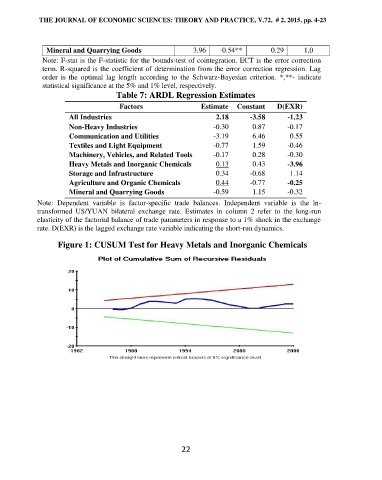
                         Figure 1: CUSUM Test for Heavy Metals and Inorganic Chemicals


                                                           22

