


Page 19 - Azerbaijan State University of Economics
P. 19
N.Akimov., S.Baizakov., A. Oinarov., E.Utembayev: The analysis of the macroeconomic
                                                dynamics and assessment of smart factors’ inputs to the balanced growth rates


                         The solution for this problem, according to A. Granberg, has been seen in the
                    close interconnection in the assessment of the ratios between the two subsets.
                          For the purposes of the study of such interconnectedness, he has carried out
                    the analyses of the three types of economic development that differ in their pre-set
                                                                               rt
                    growth rates of consumption  r  on the trajectory  с(t) = с(0)e  , and in the dynamics
                    of the rates of production consumption      . For a start, it has been assumed that
                    the parameters of the macro - technology are: coefficients А and В, and they remain
                    unchanged, in time.
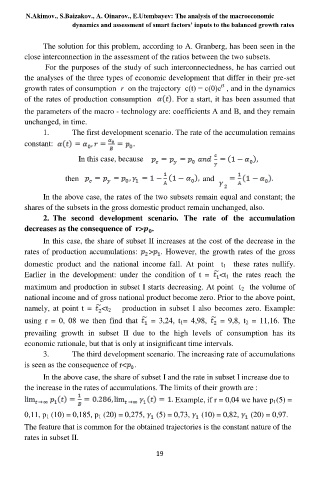
                         1.       The first development scenario. The rate of the accumulation remains
                    constant:

                                    In this case, because


                                then                                      and

                         In the above case, the rates of the two subsets remain equal and constant; the
                    shares of the subsets in the gross domestic product remain unchanged, also.
                         2.  The  second  development  scenario.  The  rate  of  the  accumulation
                    decreases as the consequence of  r>   .
                         In this case, the share of subset II increases at the cost of the decrease in the
                    rates of production accumulations:   > . However, the growth rates of the gross


                    domestic  product  and  the  national  income  fall.  At  point    t 1  these  rates  nullify.
                    Earlier  in  the  development:  under  the  condition  of  t  =   <t 1  the  rates  reach  the

                    maximum and production in subset I starts decreasing. At point  t 2  the volume of
                    national income and of gross national product become zero. Prior to the above point,
                    namely,  at  point  t  =  <t 2  —  production  in  subset  I  also  becomes  zero.  Example:

                    using  r  =  0,  08  we  then  find  that    =  3,24,  t 1=  4,98,    =  9,8,  t 2  =  11,16.  The
                    prevailing  growth  in  subset  II  due  to  the  high  levels  of  consumption  has  its
                    economic rationale, but that is only at insignificant time intervals.
                         3.       The third development scenario. The increasing rate of accumulations
                    is seen as the consequence of r<  .
                         In the above case, the share of subset I and the rate in subset I increase due to
                    the increase in the rates of accumulations. The limits of their growth are :
                                                                  Example, if r = 0,04 we have p 1(5) =

                    0,11, p 1 (10) = 0,185, p 1 (20) = 0,275,   (5) = 0,73,   (10) = 0,82,   (20) = 0,97.

                    The feature that is common for the obtained trajectories is the constant nature of the
                    rates in subset II.

                                                           19

