


Page 12 - Azerbaijan State University of Economics
P. 12
THE JOURNAL OF ECONOMIC SCIENCES: THEORY AND PRACTICE, V.76, # 2, 2019, pp. 4-20


                                           2009
                     2009
                                                                                     2017
                                                                 2017
                       23   = 260.05               23   = 551.65               23  = 475.05            23   = 963.08
                                                                 2017
                                                                                     2017
                     2009
                                           2009
                       24   = 280.00               24   = 593.97               25   = 550                25   = 1115.02
                                                                 2017
                                                                                     2017
                                                                                                25   = 550                25   = 1115.02
                                                                                                 = 1043.29

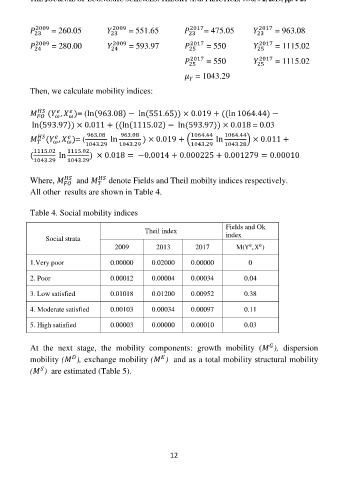
                    Then, we calculate mobility indices:


                        (   ,    )= (ln(963.08) − ln(551.65)) × 0.019 + ((ln 1064.44) −


                     ln(593.97)) × 0.011 + ((ln(1115.02) − ln(593.97)) × 0.018 = 0.03
                                             963.08
                                    963.08


                       (   ,    )= ( 1043.29  ln  1043.29  ) × 0.019 + ( 1064.44  ln  1064.44 ) × 0.011 +


                                                                           1043.28
                                                                 1043.29
                     1115.02  1115.02
                    (       ln       ) × 0.018 = −0.0014 + 0.000225 + 0.001279 = 0.00010
                     1043.29  1043.29


                    Where,            and          denote Fields and Theil mobilty indices respectively.

                    All other  results are shown in Table 4.

                    Table 4. Social mobility indices
                                                                           Fields and Ok
                                                    Theil index
                        Social strata                                      index
                                            2009       2013        2017       M(Y , X )
                                                                                  e
                                                                                     e
                    1.Very poor            0.00000    0.02000    0.00000          0
                    2. Poor                0.00012    0.00004    0.00034        0.04
                    3. Low satisfied       0.01018    0.01200    0.00952        0.38
                    4. Moderate satisfied   0.00103   0.00034    0.00097        0.11
                    5. High satisfied      0.00003    0.00000    0.00010        0.03


                    At  the  next  stage,  the  mobility  components:  growth  mobility  (   ),  dispersion


                    mobility (   ), exchange mobility (   )  and as a total mobility structural mobility

                    (   )  are estimated (Table 5).


                                                           12

