


Page 49 - Azerbaijan State University of Economics
P. 49
THE JOURNAL OF ECONOMIC SCIENCES: THEORY AND PRACTICE, V.78, # 2, 2021, pp. 43-62
In some child health literature, it is assumed that the production function is static so
that current output is a function of only current inputs. However, many human capital
variables we are concerned about are stocks, not flows. For instance, many health
variables, such as child height, weight or birth weight are cumulative measures that
depend on inputs in past periods and possibly on past health outcomes as well. In fact,
Grossman’s (1972a) seminal paper on the demand for health treats health as a capital
stock, which depends on past values and current inputs, more so in the Grossman’s
model, the demand for health is for investment and consumption purposes (Ajakaiye
and Mwabu, 2009). In the spirit of this framework, reproductive health yields direct
utility to an individual and also increases labour income through the reduction in sick
time so that more time is available for production and through increase work effort.
In this framework, the economic model of the family developed by Becker (1965)
and as applied by Frijters et al (2008) forms the analytical framework for our
analysis of the consequences of access to portable drinking water (capture as tap
water supply (APW)) on child health (capture by child ill/death due to diarrhea
diseases (CDD)). This relationship can be described within the framework of a
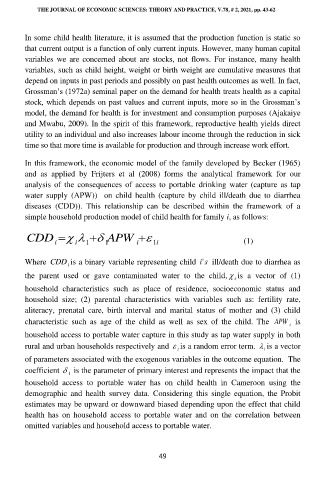
simple household production model of child health for family i, as follows:
CDD = i + 1 APW + i 1 (1)
i
i
1
Where CDD is a binary variable representing child si' ill/death due to diarrhea as
i
the parent used or gave contaminated water to the child, is a vector of (1)
i
household characteristics such as place of residence, socioeconomic status and
household size; (2) parental characteristics with variables such as: fertility rate,
aliteracy, prenatal care, birth interval and marital status of mother and (3) child
characteristic such as age of the child as well as sex of the child. The APW is
i
household access to portable water capture in this study as tap water supply in both
rural and urban households respectively and is a random error term. is a vector
i
1
of parameters associated with the exogenous variables in the outcome equation. The
coefficient is the parameter of primary interest and represents the impact that the
1
household access to portable water has on child health in Cameroon using the
demographic and health survey data. Considering this single equation, the Probit
estimates may be upward or downward biased depending upon the effect that child
health has on household access to portable water and on the correlation between
omitted variables and household access to portable water.
49

