


Page 102 - Azerbaijan State University of Economics
P. 102
THE                     JOURNAL OF ECONOMIC SCIENCES: THEORY AND PRACTICE, V.80, # 1, 2023, pp. 94-105

                    Correlation Analysis:
                    The Pearson correlation coefficient is the most common way of measuring a linear
                    correlation. It ranges from -1 to +1, where -1 indicates a perfect negative correlation,
                    0 indicates no correlation, and +1 indicates a perfect positive correlation. Pearson's
                    correlation coefficient assumes that the data is normally distributed and there is a
                    linear relationship between the two variables.

                    On the other hand, Spearman's correlation coefficient is a non-parametric measure of
                    the strength and direction of the relationship between two variables. It measures the
                    monotonic relationship between two continuous or ordinal variables. The Spearman
                    correlation coefficient ranges from -1 to +1, where -1 indicates a perfect negative
                    monotonic  correlation,  0  indicates  no  monotonic  correlation,  and  +1  indicates  a
                    perfect positive monotonic correlation. Spearman's correlation coefficient does not
                    assume that the data is normally distributed and can capture non-linear relationships
                    between the two variables.

                    To know which method to choose, it is first necessary to clarify whether the data is
                    parametric or non-parametric. For this, we will use the Shapiro-Wilk normality test.
                    If the p-value is less than 0.05, then the data is non-parametric.

                    Shapiro-Wilk, Tests of Normality (SPSS):

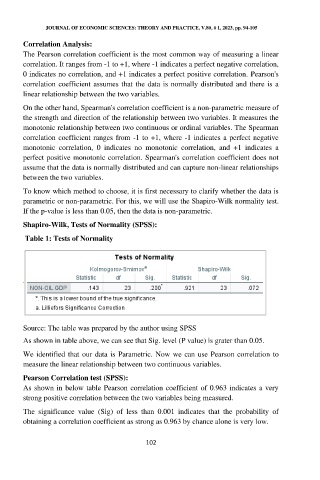
                     Table 1: Tests of Normality


                    Source: The table was prepared by the author using SPSS

                    As shown in table above, we can see that Sig. level (P value) is grater than 0.05.

                    We identified that our data is Parametric. Now we can use Pearson correlation to
                    measure the linear relationship between two continuous variables.
                    Pearson Correlation test (SPSS):
                    As shown in below table Pearson correlation coefficient of 0.963 indicates a very
                    strong positive correlation between the two variables being measured.

                    The  significance  value  (Sig)  of  less  than  0.001  indicates  that  the  probability  of
                    obtaining a correlation coefficient as strong as 0.963 by chance alone is very low.


                                                           102

