


Page 42 - Azerbaijan State University of Economics
P. 42
Nalin Ranjan: Understanding Epistemology and Methodology in Adolph Lowe’s Political Economics

                    Michael Polanyi also advocates for the logic of discovery as a heuristic exercise, where
                    instrumental analysis is like crossing over a logical gap by drawing conclusions from
                    existing knowledge and experience. Political economics provides a logical framework
                    for discovering solutions to economic problems by correctly assessing, identifying,
                    and understanding the problem (Hanson 1965, Polanyi 1962, p. 126-39).

                    Instrumental analysis starts from identification of the knowns and the unknowns in the
                    system under investigation. In this inferential procedure, unknowns are derived from the
                    knowns. Unlike traditional theory where the final state or macro-goal is unknown, we take
                    this  macro-goal  as  known  in  the  instrumental  analysis.  For  example,  in  traditional
                    mathematical models of planning like Mahalanobis’ model, Feldman’s model or Harrod-
                    Domar model, we put certain values of parameters in a given equation and thus arrive at
                    the  final  goal.  The  final  goal  is  not  postulated  before-hand,  it  is  observed  later.  The
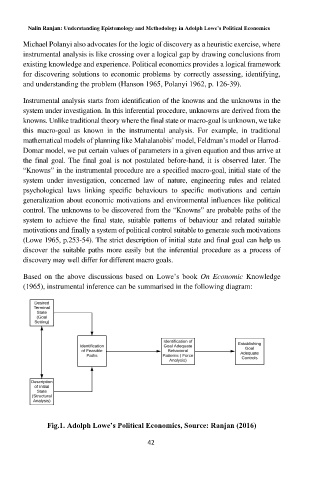
                    “Knowns” in the instrumental procedure are a specified macro-goal, initial state of the
                    system  under  investigation,  concerned  law  of  nature,  engineering  rules  and  related
                    psychological  laws  linking  specific  behaviours  to  specific  motivations  and  certain
                    generalization about economic motivations and environmental influences like political
                    control. The unknowns to be discovered from the “Knowns” are probable paths of the
                    system  to  achieve  the  final  state,  suitable  patterns  of  behaviour  and  related  suitable
                    motivations and finally a system of political control suitable to generate such motivations
                    (Lowe 1965, p.253-54). The strict description of initial state and final goal can help us
                    discover  the  suitable  paths  more  easily  but  the  inferential  procedure  as  a  process  of
                    discovery may well differ for different macro goals.

                    Based  on  the  above  discussions  based  on  Lowe’s  book  On  Economic  Knowledge
                    (1965), instrumental inference can be summarised in the following diagram:


                           Fig.1. Adolph Lowe’s Political Economics, Source: Ranjan (2016)


                                                           42

