


Page 8 - Azerbaijan State University of Economics
P. 8
THE                      JOURNAL OF ECONOMIC SCIENCES: THEORY AND PRACTICE, V.80, # 1, 2023, pp. 4-20


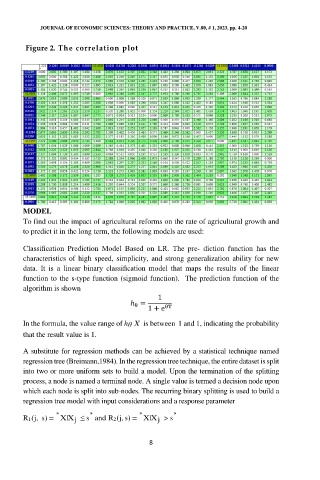
                     Figure 2. The correlation plot


                    MODEL
                    To find out the impact of agricultural reforms on the rate of agricultural growth and
                    to predict it in the long term, the following models are used:

                    Classification  Prediction  Model  Based  on  LR.  The  pre-  diction  function  has  the
                    characteristics of high speed, simplicity, and strong generalization ability for new
                    data.  It  is  a  linear  binary  classification  model  that  maps  the  results  of  the  linear
                    function to the s-type function (sigmoid function).  The prediction function of the
                    algorithm is shown
                                                               1
                                                      ℎ =
                                                       θ
                                                            1 + e θT

                    In the formula, the value range of h X  is between  1 and 1, indicating the probability
                                                     θ
                    that the result value is 1.

                    A substitute for regression methods can be achieved by a statistical technique named
                    regression tree (Breimann,1984). In the regression tree technique, the entire dataset is split
                    into two or more uniform sets to build a model. Upon the termination of the splitting
                    process, a node is named a terminal node. A single value is termed a decision node upon
                    which each node is split into sub-nodes. The recurring binary splitting is used to build a
                    regression tree model with input considerations and a response parameter
                              ,          ,               ,          ,
                    R1(j,  s) =  X|X ≤ s and R2(j, s) =  X|X > s
                                                               j
                                    j


                                                            8

