


Page 91 - Azerbaijan State University of Economics
P. 91
THE                     JOURNAL OF ECONOMIC SCIENCES: THEORY AND PRACTICE, V.80, # 1, 2023, pp. 83-93

                    RESULTS
                    The key issue of this paper is the role of gender pay disparity in economic development.
                    The first step in our study is to analyze the properties of time series variables to avoid a
                    false setback. The results of the OLS regression analysis provide preliminary support for
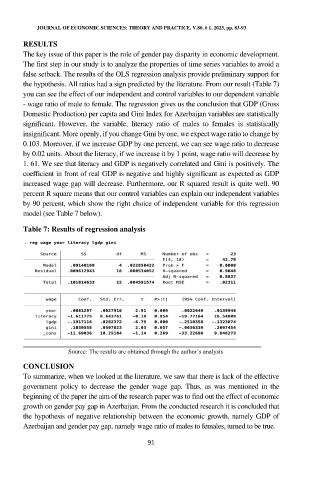
                    the hypothesis. All ratios had a sign predicted by the literature. From our result (Table 7)
                    you can see the effect of our independent and control variables to our dependent variable
                    - wage ratio of male to female. The regression gives us the conclusion that GDP (Gross
                    Domestic Production) per capita and Gini Index for Azerbaijan variables are statistically
                    significant.  However,  the  variable,  literacy  ratio  of  males  to  females  is  statistically
                    insignificant. More openly, if you change Gini by one, we expect wage ratio to change by
                    0.103. Moreover, if we increase GDP by one percent, we can see wage ratio to decrease
                    by 0.02 units. About the literacy, if we increase it by 1 point, wage ratio will decrease by
                    1. 61. We see that literacy and GDP is negatively correlated and Gini is positively. The
                    coefficient in front of real GDP is negative and highly significant as expected as GDP
                    increased wage gap will decrease. Furthermore, our R squared result is quite well. 90
                    percent R square means that our control variables can explain our independent variables
                    by 90 percent, which show the right choice of independent variable for this regression
                    model (see Table 7 below).

                    Table 7: Results of regression analysis


                                  Source: The results are obtained through the author’s analysis

                    CONCLUSION
                    To summarize, when we looked at the literature, we saw that there is lack of the effective
                    government  policy  to  decrease  the  gender  wage  gap.  Thus,  as  was  mentioned  in  the
                    beginning of the paper the aim of the research paper was to find out the effect of economic
                    growth on gender pay gap in Azerbaijan. From the conducted research it is concluded that
                    the hypothesis of negative relationship between the economic growth, namely GDP of
                    Azerbaijan and gender pay gap, namely wage ratio of males to females, turned to be true.


                                                           91

