


Page 70 - Azerbaijan State University of Economics
P. 70
THE                      JOURNAL OF ECONOMIC SCIENCES: THEORY AND PRACTICE, V.81, # 2, 2024, pp. 60-83

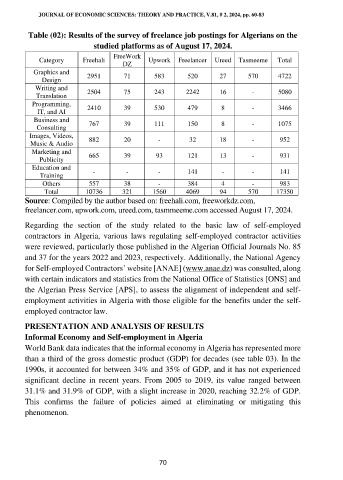
                     Table (02): Results of the survey of freelance job postings for Algerians on the
                                        studied platforms as of August 17, 2024.
                                              FreeWork
                        Category     Freehali           Upwork  Freelancer  Ureed  Tasmeeme    Total
                                                 DZ
                      Graphics and    2951       71       583       520      27       570      4722
                         Design
                       Writing and
                       Translation    2504       75       243      2242      16        -       5080
                      Programming,    2410       39       530       479       8        -       3466
                       IT, and AI
                      Business and
                       Consulting      767       39       111       150       8        -       1075
                     Images, Videos,   882       20        -        32       18        -       952
                     Music & Audio
                      Marketing and
                        Publicity      665       39        93       121      13        -       931
                      Education and     -         -        -        141       -        -       141
                        Training
                         Others        557       38        -        384       4        -       983
                         Total        10736      321      1560     4069      94       570     17350
                    Source: Compiled by the author based on: freehali.com, freeworkdz.com,
                    freelancer.com, upwork.com, ureed.com, tasmmeeme.com accessed August 17, 2024.

                    Regarding  the  section  of  the  study  related  to  the  basic  law  of  self-employed
                    contractors  in  Algeria,  various  laws  regulating  self-employed  contractor  activities
                    were reviewed, particularly those published in the Algerian Official Journals No. 85
                    and 37 for the years 2022 and 2023, respectively. Additionally, the National Agency
                    for Self-employed Contractors’ website [ANAE] (www.anae.dz) was consulted, along
                    with certain indicators and statistics from the National Office of Statistics [ONS] and
                    the Algerian Press Service [APS], to assess the alignment of independent and self-
                    employment activities in Algeria with those eligible for the benefits under the self-
                    employed contractor law.

                    PRESENTATION AND ANALYSIS OF RESULTS
                    Informal Economy and Self-employment in Algeria
                    World Bank data indicates that the informal economy in Algeria has represented more
                    than a third of the gross domestic product (GDP) for decades (see table 03). In the
                    1990s, it accounted for between 34% and 35% of GDP, and it has not experienced
                    significant  decline  in  recent  years.  From  2005  to  2019,  its  value  ranged  between
                    31.1% and 31.9% of GDP, with a slight increase in 2020, reaching 32.2% of GDP.
                    This  confirms  the  failure  of  policies  aimed  at  eliminating  or  mitigating  this
                    phenomenon.


                                                           70

