


Page 71 - Azerbaijan State University of Economics
P. 71
THE                      JOURNAL OF ECONOMIC SCIENCES: THEORY AND PRACTICE, V.82, # 2, 2025, pp. 61-78

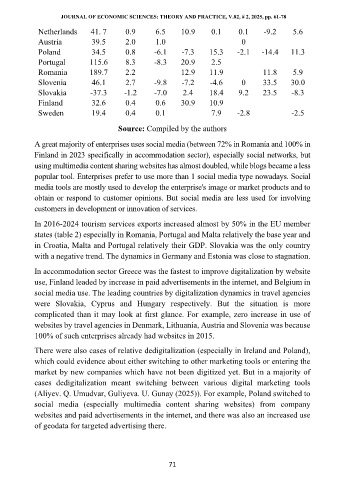
                     Netherlands    41. 7      0.9      6.5    10.9     0.1     0.1     -9.2    5.6
                     Austria         39.5      2.0      1.0                      0
                     Poland          34.5      0.8     -6.1    -7.3    15.3     -2.1   -14.4    11.3
                     Portugal       115.6      8.3     -8.3    20.9     2.5
                     Romania        189.7      2.2             12.9    11.9            11.8     5.9
                     Slovenia        46.1      2.7     -9.8    -7.2     -4.6     0     33.5     30.0
                     Slovakia       -37.3     -1.2     -7.0     2.4    18.4     9.2    23.5     -8.3
                     Finland         32.6      0.4      0.6    30.9    10.9
                     Sweden          19.4      0.4      0.1             7.9     -2.8            -2.5

                                            Source: Compiled by the authors

                    A great majority of enterprises uses social media (between 72% in Romania and 100% in
                    Finland in 2023 specifically in accommodation sector), especially social networks, but
                    using multimedia content sharing websites has almost doubled, while blogs became a less
                    popular tool. Enterprises prefer to use more than 1 social media type nowadays. Social
                    media tools are mostly used to develop the enterprise's image or market products and to
                    obtain or respond to customer opinions. But social media are less used for involving
                    customers in development or innovation of services.

                    In 2016-2024 tourism services exports increased almost by 50% in the EU member
                    states (table 2) especially in Romania, Portugal and Malta relatively the base year and
                    in Croatia, Malta and Portugal relatively their GDP. Slovakia was the only country
                    with a negative trend. The dynamics in Germany and Estonia was close to stagnation.

                    In accommodation sector Greece was the fastest to improve digitalization by website
                    use, Finland leaded by increase in paid advertisements in the internet, and Belgium in
                    social media use. The leading countries by digitalization dynamics in travel agencies
                    were  Slovakia,  Cyprus  and  Hungary  respectively.  But  the  situation  is  more
                    complicated than it may look at first glance. For example, zero increase in use of
                    websites by travel agencies in Denmark, Lithuania, Austria and Slovenia was because
                    100% of such enterprises already had websites in 2015.

                    There were also cases of relative dedigitalization (especially in Ireland and Poland),
                    which could evidence about either switching to other marketing tools or entering the
                    market by new companies which have not been digitized yet. But in a majority of
                    cases  dedigitalization  meant  switching  between  various  digital  marketing  tools
                    (Aliyev. Q. Umudvar, Guliyeva. U. Gunay (2025)). For example, Poland switched to
                    social  media  (especially  multimedia  content  sharing  websites)  from  company
                    websites and paid advertisements in the internet, and there was also an increased use
                    of geodata for targeted advertising there.


                                                           71

