


Page 86 - Azerbaijan State University of Economics
P. 86
Sathish Kumar Murugan, Ganeshkumar D.Rede, Teena Lakshmi Baskaran, Prity Kumari,
                         Alina Cristina Nuta: Determinants of Solar Water Pumping System Adoption Among
                         Farmers: A Factor
                             Analysis Approach

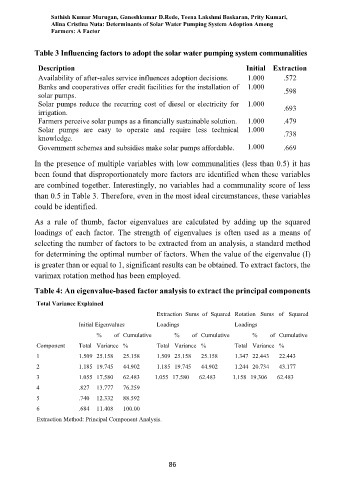
                    Table 3 Influencing factors to adopt the solar water pumping system communalities

                     Description                                                  Initial  Extraction
                     Availability of after-sales service influences adoption decisions.   1.000   .572
                     Banks and cooperatives offer credit facilities for the installation of  1.000   .598
                     solar pumps.
                     Solar pumps reduce the recurring cost of diesel or electricity for  1.000   .693
                     irrigation.
                     Farmers perceive solar pumps as a financially sustainable solution.   1.000   .479
                     Solar  pumps  are  easy  to  operate  and  require  less  technical  1.000   .738
                     knowledge.
                     Government schemes and subsidies make solar pumps affordable.   1.000   .669

                    In the presence of multiple variables with low communalities (less than 0.5) it has
                    been found that disproportionately more factors are identified when these variables
                    are combined together. Interestingly, no variables had a communality score of less
                    than 0.5 in Table 3. Therefore, even in the most ideal circumstances, these variables
                    could be identified.

                    As  a  rule  of  thumb,  factor  eigenvalues  are  calculated  by  adding  up  the  squared
                    loadings  of  each  factor.  The  strength  of  eigenvalues  is  often  used  as  a  means  of
                    selecting the number of factors to be extracted from an analysis, a standard method
                    for determining the optimal number of factors. When the value of the eigenvalue (I)
                    is greater than or equal to 1, significant results can be obtained. To extract factors, the
                    varimax rotation method has been employed.

                    Table 4: An eigenvalue-based factor analysis to extract the principal components

                    Total Variance Explained
                                                        Extraction  Sums  of  Squared  Rotation  Sums  of  Squared
                                 Initial Eigenvalues    Loadings               Loadings
                                      %    of  Cumulative    %    of  Cumulative    %    of  Cumulative
                    Component    Total  Variance  %     Total  Variance  %     Total  Variance  %
                    1            1.509  25.158   25.158   1.509  25.158   25.158   1.347  22.443   22.443
                    2            1.185  19.745   44.902   1.185  19.745   44.902   1.244  20.734   43.177
                    3            1.055  17.580   62.483   1.055  17.580   62.483   1.158  19.306   62.483
                    4            .827  13.777   76.259
                    5            .740  12.332   88.592
                    6            .684  11.408   100.00
                    Extraction Method: Principal Component Analysis.


                                                           86

