


Page 15 - Azerbaijan State University of Economics
P. 15
THE JOURNAL OF ECONOMIC SCIENCES: THEORY AND  PRACTICE, V.70,  # 2, 2013,  pp. 4-31


               society. At the same time the “traditional” society never “intends” to modernism. This society

               has such structure which postpones any possible changes and uses all necessary “tools” for it.
               Although it is quite strange, the situation described above is based on time and attitude to its

               “creatures”.  The  notion  of  the  “future”  in  the  mental  values  of  the  traditional  society  is  not
               understood  as  we  do  it  (i.e.  new,  changes,  system  updates,  and  transfer  to  higher  level  of

               society).  The  “tradition”  is  accepted  as  a  mental,  socio-economic,  socio-cultural  and  political
               notion which is a part of the time and which is also protected and desired part of society. Such

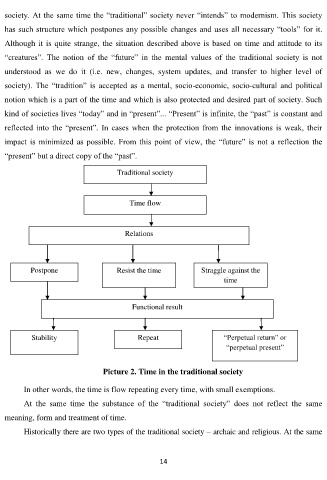
               kind of societies lives “today” and in “present”... “Present” is infinite, the “past” is constant and

               reflected into the “present”.  In cases  when the  protection from  the innovations  is  weak, their
               impact  is  minimized as possible. From this  point  of view, the “future” is  not  a reflection the

               “present” but a direct copy of the “past”.

                                                 Traditional society


                                                    Time flow


                                                   Relations


                       Postpone                 Resist the time          Straggle against the
                                                                                time


                                                     Functional result


                       Stability                       Repeat                   “Perpetual return” or
                                                                                 “perpetual present”


                                            Picture 2. Time in the traditional society

                     In other words, the time is flow repeating every time, with small exemptions.
                     At  the  same  time  the  substance  of  the  “traditional  society”  does  not  reflect  the  same

               meaning, form and treatment of time.

                     Historically there are two types of the traditional society – archaic and religious. At the same


                                                             14

