


Page 29 - Azerbaijan State University of Economics
P. 29
THE JOURNAL OF ECONOMIC SCIENCES: THEORY AND  PRACTICE, V.70,  # 2, 2013,  pp. 4-31


               about the significant issues in “present” time. Although social cognition does not allow valuation

               of future opportunities in one way, it knows what we know and what the ultimate aim is.


                                                     Transition period


                            Ontology                                                  Empiric

                 The  change  in  internal  ideal                          Distortion  of  external  forms  of
                 structure   of   socio-cultural                           socio-cultural system
                 phenomenon


                                                                   Macro-level           Micro-level
                 Macro-level              Micro-level
                                                                   Regression in all     Socio-ideological
                 Socio-cultural           “Penetration” of         levels of society     crisis in social
                 stagnation;              new ideal socio-         life                  integration process
                 creation of new          cultural structure
                 ideal structure          into the deep
                                          levels of socio-
                                          economic system


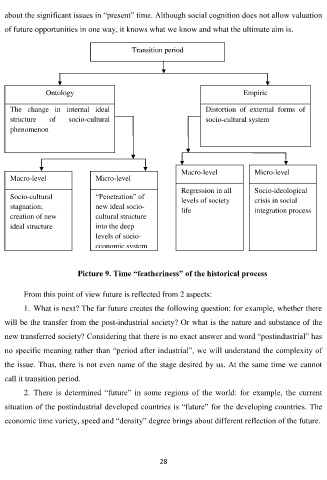
                                     Picture 9. Time “featheriness” of the historical process

                     From this point of view future is reflected from 2 aspects:

                     1.  What is next? The far future creates the following question: for example, whether there

               will be the transfer from the post-industrial society? Or what is the nature and substance of the
               new transferred society? Considering that there is no exact answer and word “postindustrial” has

               no specific meaning rather than “period after industrial”, we will understand the complexity of
               the issue. Thus, there is not even name of the stage desired by us. At the same time we cannot

               call it transition period.
                     2.  There  is  determined  “future”  in  some  regions  of  the  world:  for  example,  the  current

               situation of the postindustrial developed countries is “future” for the developing countries. The

               economic time variety, speed and “density” degree brings about different reflection of the future.


                                                             28

