


Page 134 - Azerbaijan State University of Economics
P. 134
Christian Elsner, Dennis Häckl: Health Economic value generation in the Azerbaijan Republic:
                                                                              simulatedresults for a integrated telecardiology care program


                     In  a  third  step the Scenario-Analysis takes place,  which  can be different for different


               adaptions  of the simulation.  In this step, the  technology  used or compared is specified,  the

               reference and benchmark publications are chosen and the simulation is run with a different set of

               minimum and maximum parameters from the chosen publications.


                     In the fourth and last step the simulation is custom-tailored to a specific population-mix

               according to the  parameters delivered e.g. from the payor and  the impact on the whole

               population and single patients is calculated.


                     IV. THE SELECTION OF SPECIFIC MODEL DATA

                     For the simulation model a simulated AR population mix of 167.551 people was designed:


               The population had a spread of heart failure according to New York Health Association (NYHA)

               (= I: 20%, II: 35%, III: 22%, IV: 23%), a male and female mix of 50:50, a median age of 65 with

               a standard  deviation of 12. This  mix was estimated  from  the Healthgrades ©  approximation


               [http://www.rightdiagnosis.com/c/congestive_heart_failure/stats-country.htm]. The population

               was postulated an Atrial Flutter (AF) prevalence of 6% and a 6% yearly risk of a myocardial

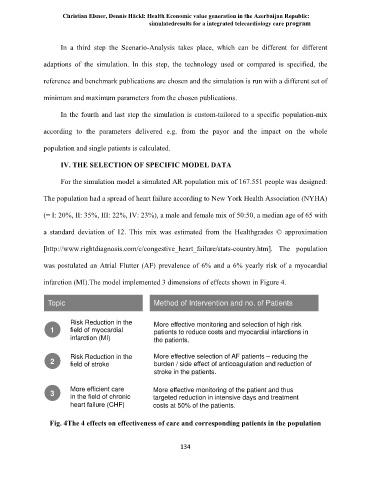
               infarction (MI).The model implemented 3 dimensions of effects shown in Figure 4.


                Topic                             Method of Intervention and no. of Patients


                        Risk Reduction in the     More effective monitoring and selection of high risk
                 1      field of myocardial       patients to reduce costs and myocardial infarctions in
                        infarction (MI)           the patients.


                        Risk Reduction in the     More effective selection of AF patients – reducing the
                 2      field of stroke           burden / side effect of anticoagulation and reduction of
                                                  stroke in the patients.


                        More efficient care       More effective monitoring of the patient and thus
                 3      in the field of chronic   targeted reduction in intensive days and treatment
                        heart failure (CHF)       costs at 50% of the patients.

                 Fig. 4The 4 effects on effectiveness of care and corresponding patients in the population


                                                           134

