


Page 70 - Azerbaijan State University of Economics
P. 70
Fariz A. Guliyev: The economics of financial securities for environmental obligations and
                                                     their impact in royalty revenues from Alberta oil sands in North America


                                   3.2.  Uncertainties and limitations on Approval Holders` use of QETs


                     Although it seems that Approval Holders can impose as much QET as possible for their tax

               purposes Alberta Environment  would presumably limit  voluntary  QETs. Thus,  voluntary

               contributions, unlike mandatory QETs, would not qualify for tax deductions. This would have a


               positive impact on  the total  amount  of royalty  collection. Another  uncertainty would  be a

               hypothetical situation where  the  bitumen production  ends whereas the Approval  Holder has

               substantial amounts of QET funded. Any subsequent withdrawal of QETs after the depletion of


               mine reserves are not depicted anywhere in the current tax regulation.

                     Why Approval Holders would use QETs during periods with high oil prices?


                     The paper  assumes  that  Approval Holders would use QETs  to deduct  costs and reduce

               royalty revenues  during  prevailing crude prices.  This is because  royalty revenues  increase  as

               WTI crude price  goes up  and Approval Holders would  be  willing to offset  this  increase by


               reducing their taxable income together with their net royalty revenue. The paper has chosen the

               year of 2011 to calculate royalty revenues for post payout projects of Alberta Energy in 2011:

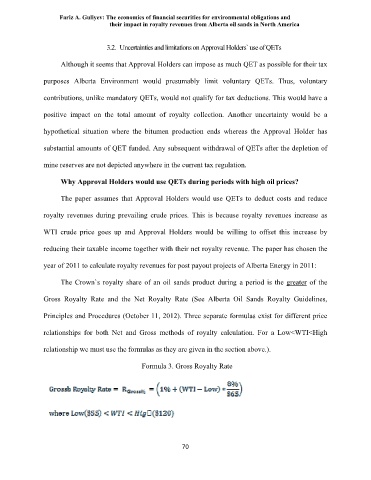
                     The Crown`s royalty share of an oil sands product during a period is the greater of the


               Gross Royalty Rate  and  the  Net Royalty  Rate  (See Alberta  Oil  Sands Royalty  Guidelines,

               Principles and Procedures (October 11, 2012). Three separate formulas exist for different price

               relationships for  both Net  and  Gross  methods  of royalty calculation.  For a Low<WTI<High


               relationship we must use the formulas as they are given in the section above.).

                                               Formula 3. Gross Royalty Rate


                                                           70

