


Page 25 - Azerbaijan State University of Economics
P. 25
N.Akimov., S.Baizakov., A. Oinarov., E.Utembayev: The analysis of the macroeconomic
                                                 dynamics and assessment of smart factors’ inputs to the balanced growth rates


                    will be in effect. It shows how much of the aggregate domestic product vanishes in
                    the course of the interim consumption‖ [Akinov, N., 2014]  The account of the entire
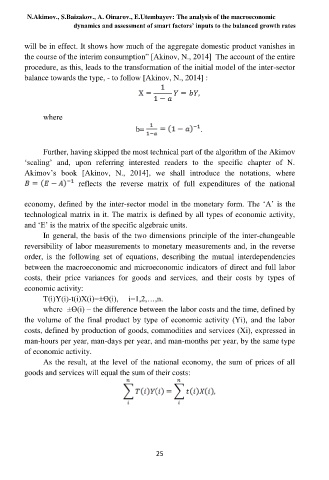
                    procedure, as this, leads to the transformation of the initial model of the inter-sector
                    balance towards the type, - to follow [Akinov, N., 2014] :


                         where

                                                     b=                  .


                         Further, having skipped the most technical part of the algorithm of the Akimov
                    ‗scaling‘  and,  upon  referring  interested  readers  to  the  specific  chapter  of  N.
                    Akimov‘s  book  [Akinov,  N.,  2014],  we  shall  introduce  the  notations,  where
                                     reflects  the  reverse  matrix  of  full  expenditures  of  the  national


                    economy, defined by the inter-sector model in the monetary form. The ‗A‘ is the
                    technological matrix in it. The matrix is defined by all types of economic activity,
                    and ‗E‘ is the matrix of the specific algebraic units.
                         In general, the basis of the two dimensions principle of the inter-changeable
                    reversibility of labor measurements to monetary measurements and, in the reverse
                    order,  is  the  following  set  of  equations,  describing  the  mutual  interdependencies
                    between the macroeconomic and microeconomic indicators of direct and full labor
                    costs,  their  price  variances  for  goods  and  services,  and  their  costs  by  types  of
                    economic activity:
                         T(i)Y(i)-t(i)X(i)=±Ө(i),     i=1,2,…,n.
                         where  ±Ө(i) – the difference between the labor costs and the time, defined by
                    the  volume  of  the  final  product  by  type  of  economic  activity  (Үi),  and  the  labor
                    costs, defined by production of goods, commodities and services (Хi), expressed in
                    man-hours per year, man-days per year, and man-months per year, by the same type
                    of economic activity.
                         As the result, at the level of the national economy, the sum of prices of all
                    goods and services will equal the sum of their costs:


                                                           25

