


Page 28 - Azerbaijan State University of Economics
P. 28
THE JOURNAL OF ECONOMIC SCIENCES: THEORY AND PRACTICE, V.73, # 1, 2016, pp. 4-37


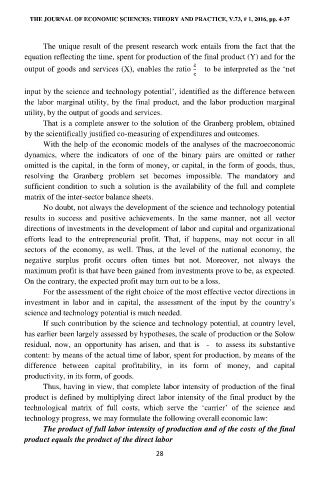
                         The unique result of the present research work entails from the fact that the
                    equation reflecting the time, spent for production of the final product (Y) and for the
                    output of goods and services (Х), enables the ratio   to be interpreted as the ‗net


                    input by the science and technology potential‘, identified as the difference between
                    the labor marginal utility, by the final product, and the labor production marginal
                    utility, by the output of goods and services.
                         That is a complete answer to the solution of the Granberg problem, obtained
                    by the scientifically justified co-measuring of expenditures and outcomes.
                         With the help of the economic models of the analyses of the macroeconomic
                    dynamics,  where  the  indicators  of  one  of  the  binary  pairs  are  omitted  or  rather
                    omitted is the capital, in the form of money, or capital, in the form of goods, thus,
                    resolving  the  Granberg  problem  set  becomes  impossible.  The  mandatory  and
                    sufficient  condition to  such a solution  is  the availability of the full  and complete
                    matrix of the inter-sector balance sheets.
                         No doubt, not always the development of the science and technology potential
                    results  in  success  and  positive  achievements.  In  the  same  manner,  not  all  vector
                    directions of investments in the development of labor and capital and organizational
                    efforts  lead  to  the  entrepreneurial  profit.  That,  if  happens,  may  not  occur  in  all
                    sectors  of  the  economy,  as  well.  Thus,  at  the  level  of  the  national  economy,  the
                    negative  surplus  profit  occurs  often  times  but  not.  Moreover,  not  always  the
                    maximum profit is that have been gained from investments prove to be, as expected.
                    On the contrary, the expected profit may turn out to be a loss.
                         For the assessment of the right choice of the most effective vector directions in
                    investment  in  labor  and  in  capital,  the  assessment  of  the  input  by  the  country‘s
                    science and technology potential is much needed.
                         If such contribution by the science and technology potential, at country level,
                    has earlier been largely assessed by hypotheses, the scale of production or the Solow
                    residual,  now,  an  opportunity  has  arisen,  and  that  is    -  to  assess  its  substantive
                    content: by means of the actual time of labor, spent for production, by means of the
                    difference  between  capital  profitability,  in  its  form  of  money,  and  capital
                    productivity, in its form, of goods.
                         Thus, having in view, that complete labor intensity of production of the final
                    product is defined by multiplying direct labor intensity of the final product by the
                    technological  matrix  of  full  costs,  which  serve  the  ‗carrier‘  of  the  science  and
                    technology progress, we may formulate the following overall economic law:
                         The product of full labor intensity of production and of the costs of the final
                    product equals the product of the direct labor

                                                           28

