


Page 46 - Azerbaijan State University of Economics
P. 46
V.Bayramov: Azerbaijan economy in 2015:  new opportunities for further diversification


                           Macroeconomic situation
                         The sharp decline in the international oil prices in 2015 has also influenced the
                    economy of Azerbaijan, after the prolonged expansion owing to higher oil prices. In
                    2015, the value-added created in the economy increased by 1.1% in real terms, being
                    54.4 billion AZN. Nonetheless, as a result of the devaluation of national currency by
                    98.7% during the reporting  year, the GDP in terms of USD experienced a 27.7%
                    contraction compared to the previous year (75.2 billion USD, 2014, World Bank).
                    That  is  to  say,  during  last  year  the  value-added  created  was  54.35  billion  USD.
                    [Akio Matsumoto, 2010]
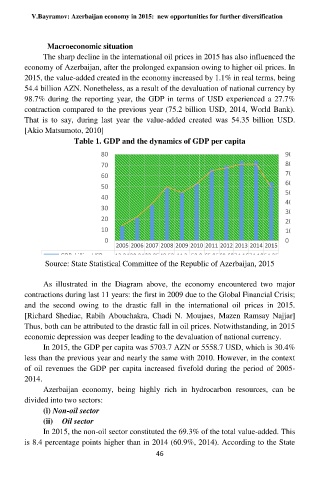
                                   Table 1. GDP and the dynamics of GDP per capita
                                           80                                                     9000
                                           70                                                     8000
                                           60                                                     7000
                                                                                                  6000
                                           50
                                                                                                  5000
                                           40
                                                                                                  4000
                                           30
                                                                                                  3000
                                           20                                                     2000
                                           10                                                     1000
                                            0                                                     0
                                               2005 2006 2007 2008 2009 2010 2011 2012 2013 2014 2015

                               GDP, billion USD  13.2420.9433.0548.52 44.3 52.9 65.9569.6874.1674.1954.35
                          Source: State Statistical Committee of the Republic of Azerbaijan, 2015
                               GDP per capita, USD 1579 2472 3842 5603 5018 5922 7285 7594 7977 79865558.7

                         As  illustrated  in  the  Diagram  above,  the  economy  encountered  two  major
                    contractions during last 11 years: the first in 2009 due to the Global Financial Crisis;
                    and  the  second  owing  to  the  drastic  fall  in  the  international  oil  prices  in  2015.
                    [Richard  Shediac,  Rabih  Abouchakra,  Chadi  N.  Moujaes,  Mazen  Ramsay  Najjar]
                    Thus, both can be attributed to the drastic fall in oil prices. Notwithstanding, in 2015
                    economic depression was deeper leading to the devaluation of national currency.
                         In 2015, the GDP per capita was 5703.7 AZN or 5558.7 USD, which is 30.4%
                    less than the previous year and nearly the same with 2010. However, in the context
                    of oil revenues  the  GDP per capita increased fivefold during the period of 2005-
                    2014.
                         Azerbaijan  economy,  being  highly  rich  in  hydrocarbon  resources,  can  be
                    divided into two sectors:
                         (i) Non-oil sector
                         (ii)  Oil sector
                         In 2015, the non-oil sector constituted the 69.3% of the total value-added. This
                    is 8.4 percentage points higher than in 2014 (60.9%, 2014). According to the State

                                                           46

