


Page 69 - Azerbaijan State University of Economics
P. 69
E.Ahmadov: Azerbaijan from innovative governance to green economy


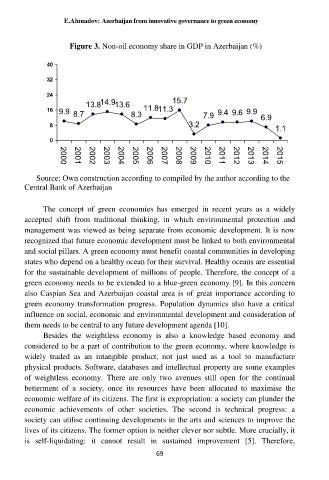
                                 Figure 3. Non-oil economy share in GDP in Azerbaijan (%)


                           40
                           32

                           24
                                      13.8 14.9 13.6            15.7
                           16  9.9  8.7             8.3 11.8 11.3         7.9  9.4 9.6 9.9  6.9

                           8                                         3.2
                                                                                               1.1
                           0


                               2000  2001  2002  2003  2004  2005  2006  2007  2008  2009  2010  2011  2012  2013  2014  2015
                       Source: Own construction according to compiled by the author according to the
                    Central Bank of Azerbaijan


                         The  concept  of  green  economies  has  emerged  in  recent  years  as  a  widely
                    accepted  shift  from  traditional  thinking,  in  which  environmental  protection  and
                    management was viewed as being separate from economic development. It is now
                    recognized that future economic development must be linked to both environmental
                    and social pillars. A green economy must benefit coastal communities in developing
                    states who depend on a healthy ocean for their survival. Healthy oceans are essential
                    for the sustainable development of millions of people. Therefore, the concept of a
                    green economy needs to be extended to a blue-green economy [9]. In this concern
                    also  Caspian Sea and Azerbaijan coastal  area is  of great  importance according to
                    green  economy  transformation  progress.  Population  dynamics  also  have  a  critical
                    influence on social, economic and environmental development and consideration of
                    them needs to be central to any future development agenda [10].
                         Besides  the  weightless  economy  is  also  a  knowledge  based  economy  and
                    considered to be a part of contribution to the green economy, where knowledge is
                    widely  traded  as  an  intangible  product,  not  just  used  as  a  tool  to  manufacture
                    physical products. Software, databases and intellectual property are some examples
                    of  weightless  economy.  There  are  only  two  avenues  still  open  for  the  continual
                    betterment  of  a  society,  once  its  resources  have  been  allocated  to  maximise  the
                    economic welfare of its citizens. The first is expropriation: a society can plunder the
                    economic  achievements  of  other  societies.  The  second  is  technical  progress:  a
                    society can utilise continuing developments in the arts and sciences to improve the
                    lives of its citizens. The former option is neither clever nor subtle. More crucially, it
                    is  self-liquidating:  it  cannot  result  in  sustained  improvement  [5].  Therefore,

                                                           69

