


Page 66 - Azerbaijan State University of Economics
P. 66
THE JOURNAL OF ECONOMIC SCIENCES: THEORY AND PRACTICE, V.73, # 1, 2016, pp. 64-77


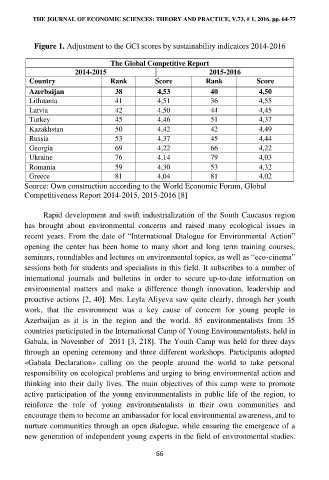
                       Figure 1. Adjustment to the GCI scores by sustainability indicators 2014-2016

                                              The Global Competitive Report
                                   2014-2015                               2015-2016
                     Country                  Rank         Score          Rank            Score
                     Azerbaijan                38           4,53            40            4,50
                     Lithuania                 41           4,51            36            4,55
                     Latvia                    42           4,50            44            4,45
                     Turkey                    45           4,46            51            4,37
                     Kazakhstan                50           4,42            42            4,49
                     Russia                    53           4,37            45            4,44
                     Georgia                   69           4,22            66            4,22
                     Ukraine                   76           4,14            79            4,03
                     Romania                   59           4,30            53            4,32
                     Greece                    81           4,04            81            4,02
                    Source: Own construction according to the World Economic Forum, Global
                    Competitiveness Report 2014-2015, 2015-2016 [8]

                         Rapid development and swift industrialization of the South Caucasus region
                    has  brought  about  environmental  concerns  and  raised  many  ecological  issues  in
                    recent years. From the date of ―International Dialogue for Environmental Action‖
                    opening  the  center  has  been  home  to  many  short  and  long  term  training  courses,
                    seminars, roundtables and lectures on environmental topics, as well as ―eco-cinema‖
                    sessions both for students and specialists in this field. It subscribes to a number of
                    international  journals  and  bulletins  in  order  to  secure  up-to-date  information  on
                    environmental  matters  and  make  a  difference  though  innovation,  leadership  and
                    proactive actions [2, 40]. Mrs. Leyla Aliyeva saw quite clearly, through her youth
                    work,  that  the  environment  was  a  key  cause  of  concern  for  young  people  in
                    Azerbaijan  as  it  is  in  the  region  and  the  world.  85  environmentalists  from  35
                    countries participated in the International Camp of Young Environmentalists, held in
                    Gabala, in November of  2011 [3, 218]. The Youth Camp was held for three days
                    through an opening ceremony and three different workshops. Participants adopted
                    «Gabala  Declaration»  calling  on  the  people  around  the  world  to  take  personal
                    responsibility on ecological problems and urging to bring environmental action and
                    thinking into their daily lives. The main objectives of this camp were to promote
                    active participation of the young environmentalists in public life of the region, to
                    reinforce  the  role  of  young  environmentalists  in  their  own  communities  and
                    encourage them to become an ambassador for local environmental awareness, and to
                    nurture communities through an open dialogue, while ensuring the emergence of a
                    new generation of independent young experts in the field of environmental studies.


                                                           66

