


Page 18 - Azerbaijan State University of Economics
P. 18
THE JOURNAL OF ECONOMIC SCIENCES: THEORY AND PRACTICE, V.74, # 2, 2017, pp. 4-31


               It  is  worth  mentioning  that  growth  in  investment  will,  mostly,  come  from  private  investment,
               where such component of investment is expected to grow at annual rates of 27.0 percent and 38.2
               percent during the SNDP period, for each of the Baseline and Hopeful Scenario respectively. This
               is including domestic private investment, remittance from diaspora [Remittances grew from $1.3
               billion  in  2013  to  estimated  $1.4  billion  in  2016  (IMF  Financial  Indicators  2013-2017).  This
               indicates 2.5 percent annual compound growth rate, and equivalent to 23 percent of GDP in 2015.
               More importantly, remittance now far exceed official development aid and FDI. Remittance from
               Somalis Diaspora are crucial to Somalia’s economy, providing a lifeline to large segments of the
               population. Remittances have been important in cushioning household economies, creating a buffer
               against  shocks  (drought,  trade  bans,  and  inter-clan  warfare).  They  fund  direct  consumption,
               including education and health, and some investment, mostly in residential construction, allowing
               Somalia to sustain its high consumption rates and to finance a large trade deficit. Remittance also
               play a very significant role to reduce the balance of payment (BoPs) deficit for the last few years.]
               and foreign direct investment (FDI). In contrast, there would be very minimum public investment,
               as there is no investment in the government budget at present and would continue for the next
               couple of years unless and until there is going to be an operational and effective aid coordination
               mechanism, where all aid given to the economy considered part and parcel of the federal budget, as
               well as there would be budget support programmes accepted and financed by various donors [It is
               worthwhile to mention that there is much public good investments being supported by external
               donors. However, these are totally outside government direct control, not using country finance
               systems, and hence, are not part of the budget neither recorder in the public accounts. Besides,
               statistical data on the totality of such an investment are difficult to determine.]. The Contribution of
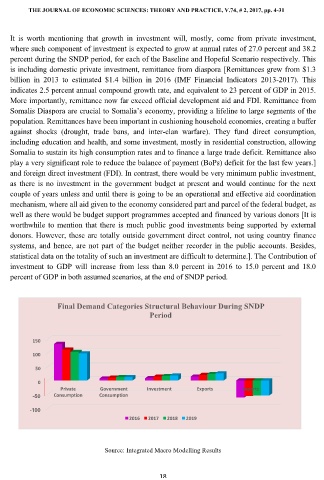
               investment  to  GDP  will  increase  from  less  than  8.0  percent  in  2016  to  15.0  percent  and  18.0
               percent of GDP in both assumed scenarios, at the end of SNDP period.


                              Final Demand Categories Structural Behaviour During SNDP
                                                          Period


                      150

                      100
                       50

                        0
                               Private	    Government	   Investment      Exports      Imports
                      -50    Consumption   Consumption

                     -100
                                                    2016  2017  2018  2019


                                            Source: Integrated Macro Modelling Results


               	                                             18

