


Page 23 - Azerbaijan State University of Economics
P. 23
Gorkhmaz Imanov, Ali Ahmadov: Estimation of the Optimal Size of Financial Depth
                                                                in Terms of Macro-Stability


                    macroeconomic,  financial,  demo  graphic  and  institutional  groups.  We  have  used
                    Global  Financial  Development  Database  of  the  World  Bank,  Heritage  Foundation
                    and  IMF’s  International  Financial  Statistics  as  well  as  Financial  Soundness
                    Indicators. For banking sector measurement, i) number of banks ii) number of bank
                    branches iii) number of banking sector employees and iv) assets of banking sector
                    were used.

                    Using quarterly data of 64 middle- and high-income countries approximated for the
                    sample  2000-2017,  we  have  analyzed  the  relationship  between  financial  deepness
                    and  economic  growth  and  its  implications  on  financial  stability.  In  general,  the
                    followings  seem  more  relevant  to  research  in  Azerbaijan  that  stem  from  the
                    empirical research conducted.

                      1.  How  financial  deepness  affects  i)  economic  growth,  ii)  macroeconomic  de-
                         stabilization  (volatility  of  economic  growth  rate)  iii)  inflation  and  iv)  financial
                         stability?
                      2. If the impact is non-linear, in what shape it is and what is the distance from
                         optimal level?
                      3. At  what  optimal  level  of  financial  markets,  maximum  level  of  economic
                         growth  and  minimum  level  of  macroeconomic,  price  and  financial
                         destabilization is achieved?

                    To  investigate  these  problems,  we  have  used  panel  regression  methodology
                    conducted  by  Rioja,  Valev  (2004),  Arcand  et  al.  (2015);  Sahay  et  al.  (2015)  and
                    finance-volatility  nexus,  Easterly  et  al.  (2000);  Beck  et  al.  (2014);  Sahay  et  al.
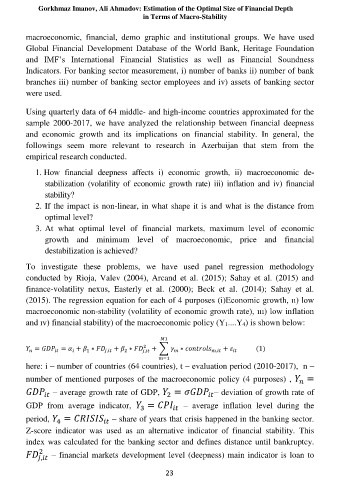
                    (2015). The regression equation for each of 4 purposes (i)Economic growth, ıı) low
                    macroeconomic non-stability (volatility of economic growth rate), ııı) low inflation
                    and ıv) financial stability) of the macroeconomic policy (Y1....Y4) is shown below:

                                                            1
                                                     2
                       =        =    +    ∗        ,      +    ∗        ,      + ∑    ∗                    ,      +                (1)


                                                2


                                     1
                                                           =1
                    here: i – number of countries (64 countries), t – evaluation period (2010-2017),  n –
                    number of mentioned purposes of the macroeconomic policy  (4 purposes) ,    =

                            – average growth rate of GDP,    =          – deviation of growth rate of
                                                            2


                    GDP  from  average  indicator,     =          –  average  inflation  level  during  the

                                                    3
                    period,    =               – share of years that crisis happened in the banking sector.
                            4

                    Z-score  indicator  was  used  as  an  alternative  indicator  of  financial  stability.  This
                    index was calculated for the banking sector and defines distance until bankruptcy.
                       2
                           ,      – financial markets development level (deepness) main indicator is loan to
                                                           23

