


Page 24 - Azerbaijan State University of Economics
P. 24
THE JOURNAL OF ECONOMIC SCIENCES: THEORY AND PRACTICE, V.76, # 1, 2019, pp. 20-33


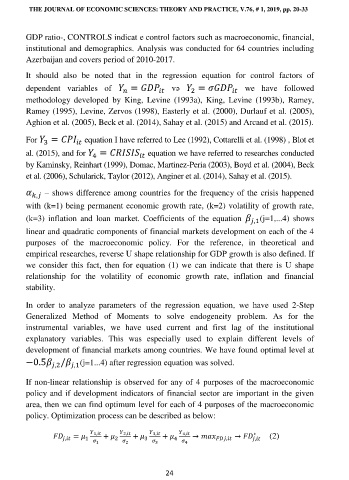
                    GDP ratio-, CONTROLS indicat e control factors such as macroeconomic, financial,
                    institutional and demographics. Analysis was conducted for 64 countries including
                    Azerbaijan and covers period of 2010-2017.

                    It  should  also  be  noted  that  in  the  regression  equation  for  control  factors  of
                    dependent  variables  of     =          və     =            we  have  followed


                                                                   2
                    methodology  developed  by  King,  Levine  (1993a),  King,  Levine  (1993b),  Ramey,
                    Ramey (1995), Levine, Zervos (1998), Easterly et al. (2000), Durlauf et al. (2005),
                    Aghion et al. (2005), Beck et al. (2014), Sahay et al. (2015) and Arcand et al. (2015).

                    For    =         equation I have referred to Lee (1992), Cottarelli et al. (1998) , Blot et
                         3

                    al. (2015), and for    =               equation we have referred to researches conducted
                                       4

                    by Kaminsky, Reinhart (1999), Domac, Martinez-Peria (2003), Boyd et al. (2004), Beck
                    et al. (2006), Schularick, Taylor (2012), Anginer et al. (2014), Sahay et al. (2015).

                         ,    – shows difference among countries for the frequency of the crisis happened

                    with (k=1) being permanent economic growth rate, (k=2) volatility of growth rate,
                    (k=3)  inflation  and  loan  market.  Coefficients  of  the  equation       ,1 (j=1,...4)  shows
                    linear and quadratic components of financial markets development on each of the 4
                    purposes  of  the  macroeconomic  policy.  For  the  reference,  in  theoretical  and
                    empirical researches, reverse U shape relationship for GDP growth is also defined. If
                    we consider this  fact, then for  equation (1)  we  can indicate that  there is U shape
                    relationship  for  the  volatility  of  economic  growth  rate,  inflation  and  financial
                    stability.

                    In  order  to  analyze  parameters  of  the  regression  equation,  we  have  used  2-Step
                    Generalized  Method  of  Moments  to  solve  endogeneity  problem.  As  for  the
                    instrumental  variables,  we  have  used  current  and  first  lag  of  the  institutional
                    explanatory  variables.  This  was  especially  used  to  explain  different  levels  of
                    development of financial markets among countries. We have found optimal level at

                    −0.5   /      ,1 (j=1...4) after regression equation was solved.
                             ,2

                    If non-linear relationship is observed for any of 4 purposes of the macroeconomic
                    policy and if development indicators of financial sector are important in the given
                    area, then we can find optimum level for each of 4 purposes of the macroeconomic
                    policy. Optimization process can be described as below:

                                                                                    ∗
                                  ,      =    1     1,      +    2     2,      +    3     3,      +    4     4,      →              ,      →          (2)
                                                                                      ,
                                          1       2        3       4


                                                           24

