


Page 30 - Azerbaijan State University of Economics
P. 30
Gorkhmaz Imanov, Ali Ahmadov: Estimation of the Optimal Size of Financial Depth
                                                                in Terms of Macro-Stability


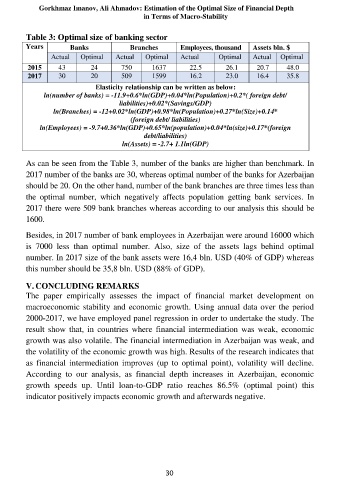
                    Table 3: Optimal size of banking sector
                    Years       Banks            Branches       Employees, thousand    Assets bln. $
                           Actual   Optimal   Actual   Optimal   Actual    Optimal   Actual   Optimal
                    2015     43       24       750      1637      22.5       26.1    20.7     48.0
                    2017     30       20       509      1599      16.2       23.0    16.4     35.8
                                       Elasticity relationship can be written as below:
                         ln(number of banks) = -11.9+0.6*ln(GDP)+0.04*ln(Population)+0.2*( foreign debt/
                                              liabilities)+0.02*(Savings/GDP)
                            ln(Branches) = -12+0.02*ln(GDP)+0.98*ln(Population)+0.27*ln(Size)+0.14*
                                                 (foreign debt/ liabilities)
                        ln(Employees) = -9.7+0.36*ln(GDP)+0.65*ln(population)+0.04*ln(size)+0.17*(foreign
                                                     debt/liabilities)
                                               ln(Assets) = -2.7+ 1.1ln(GDP)

                    As can be seen from the Table 3, number of the banks are higher than benchmark. In
                    2017 number of the banks are 30, whereas optimal number of the banks for Azerbaijan
                    should be 20. On the other hand, number of the bank branches are three times less than
                    the  optimal  number,  which  negatively  affects  population  getting  bank  services.  In
                    2017 there were 509 bank branches whereas according to our analysis this should be
                    1600.

                    Besides, in 2017 number of bank employees in Azerbaijan were around 16000 which
                    is  7000  less  than  optimal  number.  Also,  size  of  the  assets  lags  behind  optimal
                    number. In 2017 size of the bank assets were 16,4 bln. USD (40% of GDP) whereas
                    this number should be 35,8 bln. USD (88% of GDP).

                    V. CONCLUDING REMARKS
                    The  paper  empirically  assesses  the  impact  of  financial  market  development  on
                    macroeconomic stability and economic growth. Using annual data over the period
                    2000-2017, we have employed panel regression in order to undertake the study. The
                    result show that, in countries where  financial intermediation was weak,  economic
                    growth was also volatile. The financial intermediation in Azerbaijan was weak, and
                    the volatility of the economic growth was high. Results of the research indicates that
                    as  financial  intermediation  improves  (up  to  optimal  point),  volatility  will  decline.
                    According  to  our  analysis,  as  financial  depth  increases  in  Azerbaijan,  economic
                    growth  speeds  up.  Until  loan-to-GDP  ratio  reaches  86.5%  (optimal  point)  this
                    indicator positively impacts economic growth and afterwards negative.


                                                           30

