


Page 73 - Azerbaijan State University of Economics
P. 73
Yadulla Hasanli, Sudabe Salihova: A Comparative Analysis of Tourism Sectors of Azerbaijan,
                                                                                Turkey and Kazakhstan Through İnput-Output Tables
                   Analysis
                    the two countries could contribute  to economic cooperation and trade in the benefit

                     of  the  two  countries  if  converted  into  cost  advantages  for  both  Turkey  and
                    Kazakhstan (2014).

                    Many studies have been done with the input-output analysis approach for different
                    sectors of the Turkish economy. Çakır and Bostan (2000), Dilber (2007), Sarıışık
                    and others (2011), they investigated the effects of tourism on the Turkish economy.


                   3. THEORETHICAL AND METHODOLOGICAL BASICS OF "INPUT-
                     OUTPUT" MODEL

                    The Sectorial Input-Output table is composed of three parts:

                    I part shows the mutual interconnections of sectors (rows indicates the intermediate
                    goods, and the columns shows quantities of goods and services received from other
                    industry  sectors  to  perform  their  own  production  about  to  be  intermediate
                    consumption expenditures) (Calculation of GDP by production method);

                    II part shows the components of the final product (consumption, investment, public
                    expenditures, exports, imports) (Calculation of GDP by expenditure method);

                    III  part  reflects  the  components  of  Value  Added  (wages,  profit,  depreciation,
                    interest etc.), in other words, the calculation of GDP by income (Hasanli, 2011, s.
                    17)

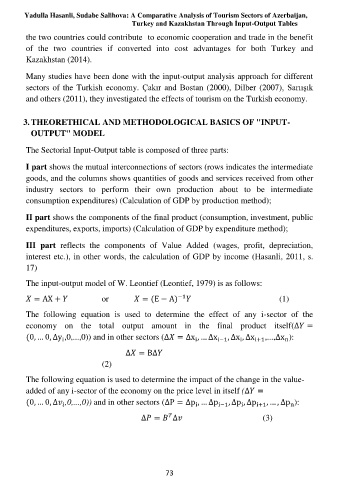
                    The input-output model of W. Leontief (Leontief, 1979) is as follows:
                                                               −1
                       = AX +                   or               = (E − A)                        (1)
                    The  following  equation  is  used  to  determine  the  effect  of  any  i-sector  of  the
                    economy  on  the  total  output  amount  in  the  final  product  itself(∆   =
                    (0, … 0, ∆y ,0,...,0)) and in other sectors (∆   = ∆x , … ∆x i−1 , ∆x , ∆x i+1 ,...,∆x ):
                                                                                             n
                                                                    i
                                                                                 i
                              i
                                                ∆   = B∆
                                          (2)
                    The following equation is used to determine the impact of the change in the value-

                    added of any i-sector of the economy on the price level in itself (∆   =
                    (0, … 0, ∆   ,0,...,0)) and in other sectors (∆P = ∆p , … ∆p i−1 , ∆p , ∆p i+1 , … , ∆p ):
                                                                                               n
                                                                                 i
                                                                    i

                                                    ∆   =    ∆                             (3)


                                                           73

