


Page 74 - Azerbaijan State University of Economics
P. 74
THE JOURNAL OF ECONOMIC SCIENCES: THEORY AND PRACTICE, V.76, # 1, 2019, pp. 70-82


                    Here, the ∆   shows -price level,   ℎ        −            −                      , B is the transpose
                    of the total expense matrix.

                    The effectiveness of the total output amount on the employment can be determined
                    by the following equation:
                                  ∆   =   ∆       or    ∆   =     ∆                                   (4)

                    Here, ΔY- indicates upcoming changes in employment (ΔL) as a result of the change
                    in final product, t- is the direct labor density coefficient, in other words, the labor
                    force needed to output a unit in each sector (person-hour, person-day, person-year).

                    4. EMİRİCAL  ESTİMATİON  IN  THE  CASE OF  AZERBAİJAN,  TURKEY
                      AND KAZAKHSTAN

                    In  this  study,  according  to  the  report  published  by  the  statistical  institutions  the
                    “İnput-output” simulations models for the 15 sectors of Azerbaijan economy (2006),
                    59 sectors of Turkey economy (TÜİK, 2002) and 29 sectors of Kazakhstan economy
                    (ASRK, 2007) based on the “İnput-output” tables were carried out.
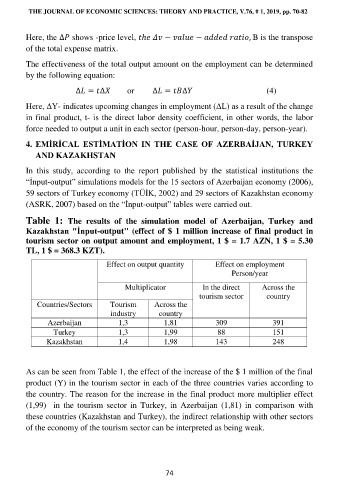
                    Table  1:  The  results  of  the  simulation  model  of  Azerbaijan,  Turkey  and
                    Kazakhstan "İnput-output" (effect of $ 1 million increase of final product in
                    tourism sector on output amount and employment, 1 $ = 1.7 AZN, 1 $ = 5.30
                    TL, 1 $ = 368.3 KZT).

                                           Effect on output quantity      Effect on employment
                                                                              Person/year
                                                Multiplicator         In the direct    Across the
                                                                     tourism sector     country
                       Countries/Sectors    Tourism     Across the
                                            industry      country
                          Azerbaijan          1,3          1,81           309             391
                            Turkey            1,3          1,99           88              151
                          Kazakhstan          1,4          1,98           143             248


                    As can be seen from Table 1, the effect of the increase of the $ 1 million of the final
                    product (Y) in the tourism sector in each of the three countries varies according to
                    the country. The reason for the increase in the final product more multiplier effect
                    (1,99)    in  the  tourism  sector  in  Turkey,  in  Azerbaijan  (1,81)  in  comparison  with
                    these countries (Kazakhstan and Turkey), the indirect relationship with other sectors
                    of the economy of the tourism sector can be interpreted as being weak.


                                                           74

