


Page 24 - Azerbaijan State University of Economics
P. 24
Aynur Suleymanova: Assessment of Laffer Points of the I and II Types of VAT (on the
                      Example of Russian Federation, Kazakhstan and Azerbaijan Republics


                    Here  GDP_CURP_NC_RF  is  GDP  at  current  prices  of  the  Russian  Federation,
                    VAT_TB_RF is the level of tax burden on VAT in Russian Federation.
                    The following result was obtained from the econometric evaluation of the regression
                    equation (1):

                    LOG(GDP_CURP_NC_RF) = 6.41058559254* VAT_TB _RF - 0.575389897779* VAT_
                    TB _RF^2 + [AR (1) =0.902725244679]                                                 (2)
                    (t-Statistic)  (46.74186)                            (-35.33396)
                    R-squared = 0.707600; Adjusted R-squared = 0.597950; Durbin-Watson stat = 1.779558

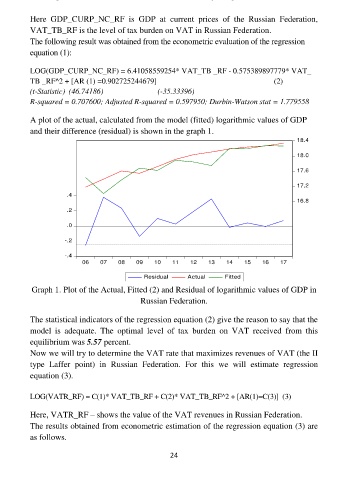
                    A plot of the actual, calculated from the model (fitted) logarithmic values of GDP
                    and their difference (residual) is shown in the graph 1.
                                                                                               18.4
                                                                                               18.0

                                                                                               17.6

                                                                                               17.2
                              .4
                                                                                               16.8
                              .2

                              .0
                              -.2

                              -.4
                                   06   07   08   09   10   11   12   13   14   15    16   17

                                                    Residual    Actual     Fitted

                    Graph 1. Plot of the Actual, Fitted (2) and Residual of logarithmic values of GDP in
                                                   Russian Federation.

                    The statistical indicators of the regression equation (2) give the reason to say that the
                    model  is  adequate.  The  optimal  level  of  tax  burden  on  VAT  received  from  this
                    equilibrium was 5.57 percent.
                    Now we will try to determine the VAT rate that maximizes revenues of VAT (the II
                    type  Laffer  point)  in  Russian  Federation.  For  this  we  will  estimate  regression
                    equation (3).

                    LOG(VATR_RF) = C(1)* VAT_TB_RF + C(2)* VAT_TB_RF^2 + [AR(1)=C(3)]  (3)

                    Here, VATR_RF – shows the value of the VAT revenues in Russian Federation.
                    The results obtained from econometric estimation of the regression equation (3) are
                    as follows.

                                                           24

