


Page 26 - Azerbaijan State University of Economics
P. 26
Aynur Suleymanova: Assessment of Laffer Points of the I and II Types of VAT (on the
                       Example of Russian Federation, Kazakhstan and Azerbaijan Republics


                                                                                            2,000,000

                                                                                            1,600,000


                           800,000                                                          1,200,000


                           400,000                                                          800,000


                                0                                                           400,000

                           -400,000


                           -800,000
                                    06   07  08   09   10  11   12   13   14  15   16   17

                                                    Residual    Actual   Fitted


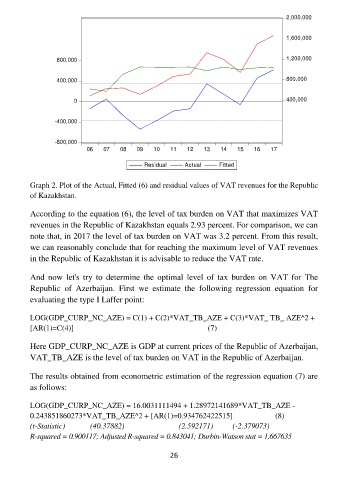
                    Graph 2. Plot of the Actual, Fitted (6) and residual values of VAT revenues for the Republic
                    of Kazakhstan.

                    According to the equation (6), the level of tax burden on VAT that maximizes VAT
                    revenues in the Republic of Kazakhstan equals 2.93 percent. For comparison, we can
                    note that, in 2017 the level of tax burden on VAT was 3.2 percent. From this result,
                    we can reasonably conclude that for reaching the maximum level of VAT revenues
                    in the Republic of Kazakhstan it is advisable to reduce the VAT rate.

                    And  now  let's  try  to  determine  the  optimal  level  of  tax  burden  on  VAT  for  The
                    Republic  of  Azerbaijan.  First  we  estimate  the  following  regression  equation  for
                    evaluating the type I Laffer point:

                    LOG(GDP_CURP_NC_AZE) = C(1) + C(2)*VAT_TB_AZE + C(3)*VAT_ TB_ AZE^2 +
                    [AR(1)=C(4)]                                      (7)

                    Here GDP_CURP_NC_AZE is GDP at current prices of the Republic of Azerbaijan,
                    VAT_TB_AZE is the level of tax burden on VAT in the Republic of Azerbaijan.

                    The results obtained from econometric estimation of the regression equation (7) are
                    as follows:

                    LOG(GDP_CURP_NC_AZE) = 16.0031111494 + 1.28972141689*VAT_TB_AZE -
                    0.243851860273*VAT_TB_AZE^2 + [AR(1)=0.934762422515]                      (8)
                    (t-Statistic)             (40.37882)                            (2.592171)          (-2.379073)
                    R-squared = 0.900117; Adjusted R-squared = 0.843041; Durbin-Watson stat = 1.667635

                                                           26

