


Page 30 - Azerbaijan State University of Economics
P. 30
Vugar Rahimov, Nigar Jafarova: The Exchange Rate Pass-Through to Aggregate
                                                                  Consumer Price Index and Its Components In Azerbaijan

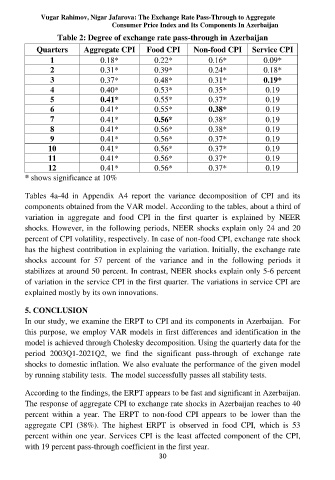
                             Table 2: Degree of exchange rate pass-through in Azerbaijan
                       Quarters      Aggregate CPI      Food CPI      Non-food CPI     Service CPI
                           1              0.18*           0.22*           0.16*           0.09*
                           2              0.31*           0.39*           0.24*           0.18*
                           3              0.37*           0.48*           0.31*           0.19*
                           4              0.40*           0.53*           0.35*            0.19
                           5              0.41*           0.55*           0.37*            0.19
                           6              0.41*           0.55*           0.38*            0.19
                           7              0.41*           0.56*           0.38*            0.19
                           8              0.41*           0.56*           0.38*            0.19
                           9              0.41*           0.56*           0.37*            0.19
                           10             0.41*           0.56*           0.37*            0.19
                           11             0.41*           0.56*           0.37*            0.19
                           12             0.41*           0.56*           0.37*            0.19
                    * shows significance at 10%

                    Tables  4a-4d  in  Appendix  A4  report  the  variance  decomposition  of  CPI  and  its
                    components obtained from the VAR model. According to the tables, about a third of
                    variation  in  aggregate  and  food  CPI  in  the  first  quarter  is  explained  by  NEER
                    shocks. However, in the following periods, NEER shocks explain only 24 and 20
                    percent of CPI volatility, respectively. In case of non-food CPI, exchange rate shock
                    has the highest contribution in explaining the variation. Initially, the exchange rate
                    shocks  account  for  57  percent  of  the  variance  and  in  the  following  periods  it
                    stabilizes at around 50 percent. In contrast, NEER shocks explain only 5-6 percent
                    of variation in the service CPI in the first quarter. The variations in service CPI are
                    explained mostly by its own innovations.

                    5. CONCLUSION
                    In our study, we examine the ERPT to CPI and its components in Azerbaijan.  For
                    this purpose, we employ VAR models in first differences and identification in the
                    model is achieved through Cholesky decomposition. Using the quarterly data for the
                    period  2003Q1-2021Q2,  we  find  the  significant  pass-through  of  exchange  rate
                    shocks to domestic inflation. We also evaluate the performance of the given model
                    by running stability tests.  The model successfully passes all stability tests.

                    According to the findings, the ERPT appears to be fast and significant in Azerbaijan.
                    The response of aggregate CPI to exchange rate shocks in Azerbaijan reaches to 40
                    percent  within  a  year.  The  ERPT  to  non-food  CPI  appears  to  be  lower  than  the
                    aggregate  CPI  (38%).  The  highest  ERPT  is  observed  in  food  CPI,  which  is  53
                    percent within one year. Services CPI is the least affected component of the CPI,
                    with 19 percent pass-through coefficient in the first year.
                                                           30

