


Page 79 - Azerbaijan State University of Economics
P. 79
Abrehet Mehari: Factors Affect The Productivity of Large And Medium -Scale
Manufacturing Industry In Ethiopia
The factor productivity index measures factor productivity changes by calculating
the weighted differences in the growth rates of outputs and inputs. The growth rates
are in log-ratio form, and the weights are revenue and cost shares for outputs and
inputs, respectively.
THE MODEL
The focus of this study is to analyze the determinants of factor productivity in the
medium and large-scale manufacturing sector by using time series data over 2001-
2017. Once the factor of productivity is estimated by using the Tornqvist-Theil
technique, the following estimable time series model is specified to investigate the
factor of productivity that can be measured in terms of single-factor productivity
measures, and multi-factor productivity measures.(Tsegay et.al, 2017). in the
medium and large-scale manufacturing sector in Ethiopia.
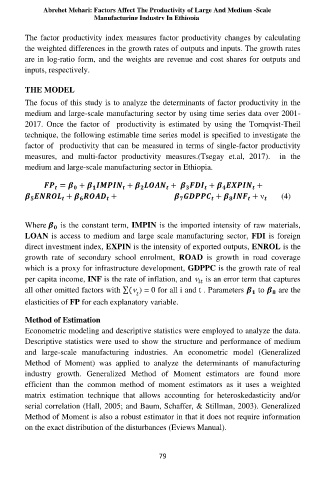
= + + + + +
+ + + + (4)
Where is the constant term, IMPIN is the imported intensity of raw materials,
LOAN is access to medium and large scale manufacturing sector, FDI is foreign
direct investment index, EXPIN is the intensity of exported outputs, ENROL is the
growth rate of secondary school enrolment, ROAD is growth in road coverage
which is a proxy for infrastructure development, GDPPC is the growth rate of real
per capita income, INF is the rate of inflation, and is an error term that captures
all other omitted factors with ∑( ) = 0 for all i and t . Parameters to are the
elasticities of FP for each explanatory variable.
Method of Estimation
Econometric modeling and descriptive statistics were employed to analyze the data.
Descriptive statistics were used to show the structure and performance of medium
and large-scale manufacturing industries. An econometric model (Generalized
Method of Moment) was applied to analyze the determinants of manufacturing
industry growth. Generalized Method of Moment estimators are found more
efficient than the common method of moment estimators as it uses a weighted
matrix estimation technique that allows accounting for heteroskedasticity and/or
serial correlation (Hall, 2005; and Baum, Schaffer, & Stillman, 2003). Generalized
Method of Moment is also a robust estimator in that it does not require information
on the exact distribution of the disturbances (Eviews Manual).
79

