


Page 23 - Azerbaijan State University of Economics
P. 23
THE        JOURNAL OF ECONOMIC SCIENCES: THEORY AND PRACTICE, V.79, # 2, 2022, pp. 19-36

                    GDP = The sum of the gross value added at basic prices plus all taxes on products,
                    less all subsidies on products

                    Value added = Compensation of employees + Mixed income + Other taxes less
                    subsidies on production + Gross operating surplus

                    Gross operating surplus = Net operating surplus + Consumption of fixed capital.

                    The share of interest incomes on loans granted by banks of Azerbaijan for 2018-2021
                    averaged  58%  of  total  bank  incomes  which  includes  the  interest  and  non-interest
                    incomes. (Source: Calculation made by author based on data obtained from the official
                    web-site of Central Bank of the Republic of Azerbaijan, https://www.cbar.az/). In the
                    study the accrued interest incomes calculated on bank loans divided by GDP is defined
                    as interest burden. Theoretically, a rise in the interest burden results in delays and non-
                    payment of debts in the economy, which causes the establishment of special reserves
                    funds by banks for outstanding debts (both principal and interest) by debiting of profit
                    and loss account. As a rule, special reserve funds are created at the expense of banks,
                    which in its turn has a reducing effect on the profits of banks. An increase in the
                    interest burden theoretically has an effect on banks' profits. However, there is a certain
                    point  at  which  the  impact  of  the  interest  burden  on  the  bank's  profits  reaches  its
                    maximum. After this point, the interest burden reduces the solvency of borrowers and,
                    consequently, leads to delays or defaults, which reduces the profitability of the bank
                    by increasing the cost of the reserve fund. Because the reserves are created at the
                    expense of the bank for the total amount of loans. (The Chamber for Control over
                    Financial  Markets  of  the  Republic  of  Azerbaijan,  2018,  http://www.e-
                    qanun.az/framework/40823).

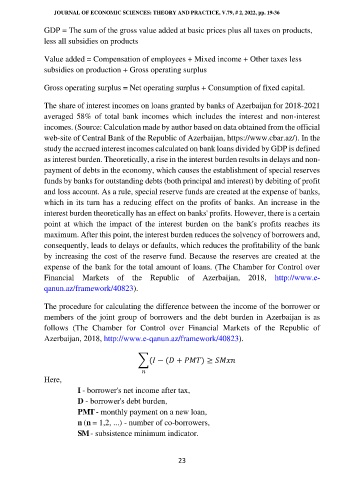
                    The procedure for calculating the difference between the income of the borrower or
                    members of the joint group of borrowers and the debt burden in Azerbaijan is as
                    follows  (The  Chamber  for  Control  over  Financial  Markets  of  the  Republic  of
                    Azerbaijan, 2018, http://www.e-qanun.az/framework/40823).

                                                ∑(   − (   +       ) ≥

                    Here,
                              I - borrower's net income after tax,
                              D - borrower's debt burden,
                              PMT - monthly payment on a new loan,
                              n (n = 1,2, ...) - number of co-borrowers,
                              SM - subsistence minimum indicator.


                                                           23

