


Page 27 - Azerbaijan State University of Economics
P. 27
THE        JOURNAL OF ECONOMIC SCIENCES: THEORY AND PRACTICE, V.79, # 2, 2022, pp. 19-36

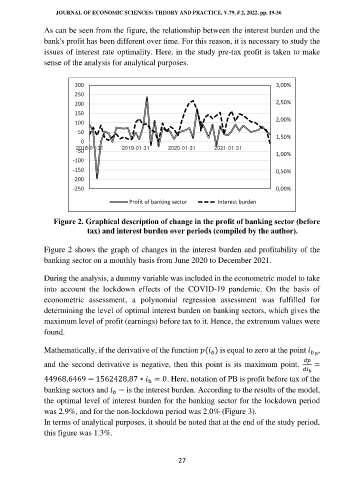
                    As can be seen from the figure, the relationship between the interest burden and the
                    bank's profit has been different over time. For this reason, it is necessary to study the
                    issues of interest rate optimality. Here, in the study pre-tax profit is taken to make
                    sense of the analysis for analytical purposes.

                             300                                                        3,00%
                             250
                             200                                                        2,50%
                             150
                                                                                        2,00%
                             100
                              50
                                                                                        1,50%
                               0
                             2018-01-31    2019-01-31   2020-01-31    2021-01-31
                             -50
                                                                                        1,00%
                            -100
                            -150                                                        0,50%
                            -200
                            -250                                                        0,00%
                                             Profit of banking sector  Interest burden

                       Figure 2. Graphical description of change in the profit of banking sector (before
                                tax) and interest burden over periods (compiled by the author).

                    Figure 2 shows the graph of changes in the interest burden and profitability of the
                    banking sector on a monthly basis from June 2020 to December 2021.

                    During the analysis, a dummy variable was included in the econometric model to take
                    into  account  the  lockdown  effects  of  the  COVID-19  pandemic.  On  the  basis  of
                    econometric  assessment,  a  polynomial  regression  assessment  was  fulfilled  for
                    determining the level of optimal interest burden on banking sectors, which gives the
                    maximum level of profit (earnings) before tax to it. Hence, the extremum values were
                    found.

                    Mathematically, if the derivative of the function   (   ) is equal to zero at the point    ,


                                                                                                    0
                    and the second derivative is negative, then this point is its maximum point.         =

                    44968,6469 − 1562428,87 ∗    = 0. Here, notation of PB is profit before tax of the
                                                  b
                    banking sectors and    − is the interest burden. According to the results of the model,

                    the optimal level of interest burden for the banking sector for the lockdown period
                    was 2.9%, and for the non-lockdown period was 2.0% (Figure 3).
                    In terms of analytical purposes, it should be noted that at the end of the study period,
                    this figure was 1.3%.


                                                           27

