


Page 72 - Azerbaijan State University of Economics
P. 72
Kanan Fadani: Impact Of Digital Consumption And Factors Affecting It: The Example
                                                        Of Azerbaijan

                    Data Analysis and Model Testing
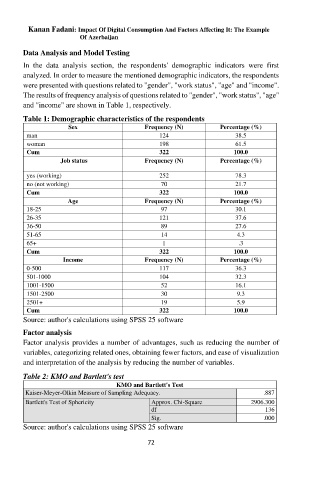
                    In  the  data  analysis  section,  the  respondents'  demographic  indicators  were  first
                    analyzed. In order to measure the mentioned demographic indicators, the respondents
                    were presented with questions related to "gender", "work status", "age" and "income".
                    The results of frequency analysis of questions related to "gender", "work status", "age"
                    and "income" are shown in Table 1, respectively.

                    Table 1: Demographic characteristics of the respondents
                                  Sex                     Frequency (N)            Percentage (%)
                     man                                       124                     38.5
                     woman                                     198                     61.5
                     Cum                                       322                     100.0
                                Job status                Frequency (N)            Percentage (%)

                     yes (working)                             252                     78.3
                     no (not working)                           70                     21.7
                     Cum                                       322                     100.0
                                  Age                     Frequency (N)            Percentage (%)
                     18-25                                      97                     30.1
                     26-35                                     121                     37.6
                     36-50                                      89                     27.6
                     51-65                                      14                      4.3
                     65+                                        1                       .3
                     Cum                                       322                     100.0
                                Income                    Frequency (N)            Percentage (%)
                     0-500                                     117                     36.3
                     501-1000                                  104                     32.3
                     1001-1500                                  52                     16.1
                     1501-2500                                  30                      9.3
                     2501+                                      19                      5.9
                     Cum                                       322                     100.0
                    Source: author's calculations using SPSS 25 software

                    Factor analysis
                    Factor analysis provides a number of advantages, such as reducing the number of
                    variables, categorizing related ones, obtaining fewer factors, and ease of visualization
                    and interpretation of the analysis by reducing the number of variables.

                    Table 2: KMO and Bartlett's test
                                                 KMO and Bartlett's Test
                    Kaiser-Meyer-Olkin Measure of Sampling Adequacy.                            .887
                    Bartlett's Test of Sphericity            Approx. Chi-Square             2906.300
                                                             df                                  136
                                                             Sig.                               .000
                    Source: author's calculations using SPSS 25 software


                                                           72

