


Page 75 - Azerbaijan State University of Economics
P. 75
THE                     JOURNAL OF ECONOMIC SCIENCES: THEORY AND PRACTICE, V.80, # 1, 2023, pp. 67-82

                    Table 5 shows the model fit indices of the SEM analysis of the study variables. Model
                    fit indices CMIN /DF (chi-square, degrees of freedom), GFI (goodness of fit index),
                    CFI (Comparative Fit Index), RMSEA (root mean square error of approximation)
                    values were determined. In their study, Tabachnick and Fidell (2007) stated that CFI
                    and RMSEA indices are the most analyzed goodness-of-fit indices. Hair et al. (2006)
                    reported  that  CFI,  degrees  of  freedom-df,  CMIN,  and  RMSEA  values  provide
                    sufficient information in assessing model fit.

                    We can see that the value of CMIN/DF is CMIN/DF= 4.679 during the assessment of
                    compatibility indices, which is the result of the analysis . If this value is CMIN/DF≤5, it
                    means that it is an acceptable fit. GFI value was GFI=0.829. If this value is above 0.90, it
                    is indicated as an accepted value (Şimşek, 2007). If the GFI fit index obtained as a result
                    of  the  analysis  does  not  coincide  with  the  accepted  value,  it  is  marked  as  poor  fit.
                    However, in some literature, GFI values between 0.80-0.89 are also considered acceptable
                    values  (Okur  and  Yalçın-Özdilek,  2012;Segars  and  Grover,  1993).  CFI  value  was
                    CFI=0.837. A value above 0.900 is considered an acceptable fit. If the GFI fit index
                    obtained as a result of the analysis does not coincide with the accepted value, it is marked
                    as poor fit. The last RMSEA value mentioned in the table was RMSEA=0.107. This value
                    is considered as an acceptable fit when RMSEA≤0.08.

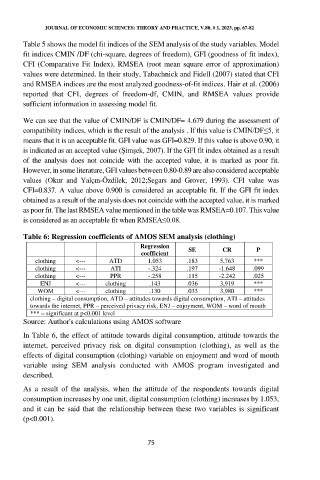
                    Table 6: Regression coefficients of AMOS SEM analysis (clothing)
                                                         Regression     SE         CR         P
                                                         coefficient
                        clothing     <---      ATD         1.053        .183       5,763     ***
                        clothing     <---       ATI         -.324       .197      -1.648     .099
                        clothing     <---      PPR          -.258       .115      -2.242     .025
                         ENJ         <---     clothing      .143        .036       3,919     ***
                        WOM          <---     clothing      .130        .033       3,980     ***
                      clothing – digital consumption, ATD – attitudes towards digital consumption, ATI – attitudes
                      towards the internet, PPR – perceived privacy risk, ENJ – enjoyment, WOM – word of mouth
                      *** = significant at p<0.001 level
                    Source: Author's calculations using AMOS software

                    In Table 6, the effect of attitude towards digital consumption, attitude towards the
                    internet,  perceived  privacy  risk  on  digital  consumption  (clothing),  as  well  as  the
                    effects of digital consumption (clothing) variable on enjoyment and word of mouth
                    variable  using  SEM  analysis  conducted  with  AMOS  program  investigated  and
                    described.

                    As  a  result  of  the  analysis,  when  the  attitude  of  the  respondents  towards  digital
                    consumption increases by one unit, digital consumption (clothing) increases by 1.053,
                    and it can be said  that the relationship between  these two variables is  significant
                    (p<0.001).


                                                           75

