


Page 12 - Azerbaijan State University of Economics
P. 12
THE                      JOURNAL OF ECONOMIC SCIENCES: THEORY AND PRACTICE, V.81, # 1, 2024, pp. 4-21


                    Table number (04) shows that the variables are not significant at the 5% level, meaning
                    they  are  non-stationary  at  level  due  to  the  presence  of  a  unit  root,  which  means
                    accepting the null hypothesis. After re-testing the variables at the first difference, both
                    series were stable at the 1% significance level, i.e., free from the unit root, leading to
                    the acceptance of the alternative hypothesis and the rejection of the null hypothesis.
                    Therefore, the study variables are integrated of order one I (1).

                    Results of Estimating the Study Model
                    To understand the impact of FDI on economic development, the model is estimated, and
                    various diagnostic tests are conducted to ensure the authenticity of the estimated results .

                    Estimation of the FARDL Model
                    The stability study results reveal that the study variables, economic development (GDP)
                    and FDI (FDI), are integrated of the same order I(1), suggesting the possibility of a long-
                    term  cointegration  link  between  these  variables  within  the  FARDL  methodology
                    framework, which is considered one of the best models for studying cointegration .
                    Choosing the Optimal Lag Length for the FARDL Model
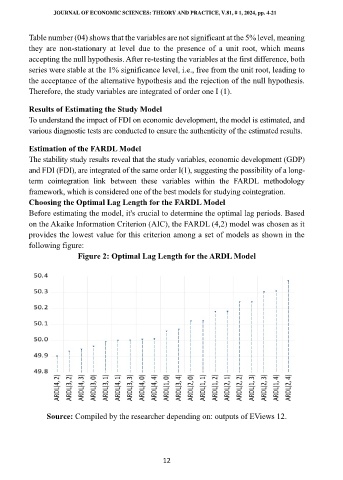
                    Before estimating the model, it's crucial to determine the optimal lag periods. Based
                    on the Akaike Information Criterion (AIC), the FARDL (4,2) model was chosen as it
                    provides the lowest value for this criterion among a set of models as shown in the
                    following figure:
                                  Figure 2: Optimal Lag Length for the ARDL Model


                         Source: Compiled by the researcher depending on: outputs of EViews 12.


                                                           12

