


Page 57 - Azerbaijan State University of Economics
P. 57
THE                      JOURNAL OF ECONOMIC SCIENCES: THEORY AND PRACTICE, V.81, # 1, 2024, pp. 51-64

                    Methodology
                    To  analyse  relationship  between  producer  prices  and  consumer  inflation,  I  apply
                    wavelet  analysis.  Wavelet  analysis  has  been  popularized  in  scientific  fields  since
                    1980s as an alternative to Fourier transform. The wavelet approach allows us to study
                    the relationship between the variables both over time and frequency domain.

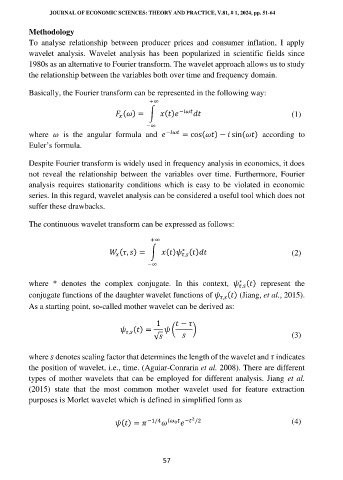
                    Basically, the Fourier transform can be represented in the following way:
                                                       +∞

                                                (  ) = ∫   (  )   −                              (1)

                                                      −∞
                    where      is  the  angular  formula  and     −        = cos(    ) −    sin(    )  according  to
                    Euler’s formula.

                    Despite Fourier transform is widely used in frequency analysis in economics, it does
                    not  reveal  the  relationship  between  the  variables  over  time.  Furthermore,  Fourier
                    analysis requires stationarity conditions  which is  easy  to  be violated in economic
                    series. In this regard, wavelet analysis can be considered a useful tool which does not
                    suffer these drawbacks.

                    The continuous wavelet transform can be expressed as follows:

                                                        +∞
                                                                 ∗
                                               (  ,   ) = ∫   (  )   (  )                        (2)
                                                                   ,

                                                       −∞

                    where  *  denotes  the  complex  conjugate.  In  this  context,     (  )  represent  the
                                                                                  ∗
                                                                                    ,
                    conjugate functions of the daughter wavelet functions of    (  ) (Jiang, et al., 2015).
                                                                              ,
                    As a starting point, so-called mother wavelet can be derived as:

                                                         1        −
                                                  (  ) =       (    )
                                                  ,
                                                         √                                       (3)

                    where    denotes scaling factor that determines the length of the wavelet and    indicates
                    the position of wavelet, i.e., time. (Aguiar-Conraria et al. 2008). There are different
                    types of mother wavelets that can be employed for different analysis. Jiang  et al.
                    (2015)  state  that  the  most  common  mother  wavelet  used  for  feature  extraction
                    purposes is Morlet wavelet which is defined in simplified form as

                                                                    2
                                               (  ) =    −1/4         0    −   /2                (4)


                                                           57

