


Page 131 - Azerbaijan State University of Economics
P. 131
THE                      JOURNAL OF ECONOMIC SCIENCES: THEORY AND PRACTICE, V.81, # 2, 2024, pp. 117-142


                                                CSR
                                             Perception


                         a= 0.4316                            b= 0.1313


                                              C=0.8966
                         Responsible
                                                                       OCB
                         Leadership                                 C' =0.8399
                                            0.0567=  Indirect Effect
                                           0.8399=  Direct Effect
                                            0.8966=  Total Effect


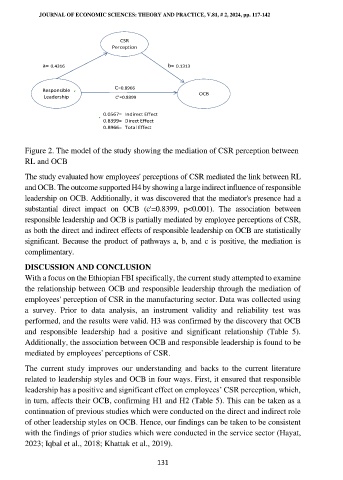
                    Figure 2. The model of the study showing the mediation of CSR perception between
                    RL and OCB

                    The study evaluated how employees' perceptions of CSR mediated the link between RL
                    and OCB. The outcome supported H4 by showing a large indirect influence of responsible
                    leadership on OCB. Additionally, it was discovered that the mediator's presence had a
                    substantial  direct  impact  on  OCB  (c'=0.8399,  p<0.001).  The  association  between
                    responsible leadership and OCB is partially mediated by employee perceptions of CSR,
                    as both the direct and indirect effects of responsible leadership on OCB are statistically
                    significant. Because the product of pathways a, b, and c is positive, the mediation is
                    complimentary.

                    DISCUSSION AND CONCLUSION
                    With a focus on the Ethiopian FBI specifically, the current study attempted to examine
                    the relationship between OCB and responsible leadership through the mediation of
                    employees' perception of CSR in the manufacturing sector. Data was collected using
                    a  survey.  Prior  to  data  analysis,  an  instrument  validity  and  reliability  test  was
                    performed, and the results were valid. H3 was confirmed by the discovery that OCB
                    and  responsible  leadership  had  a  positive  and  significant  relationship  (Table  5).
                    Additionally, the association between OCB and responsible leadership is found to be
                    mediated by employees' perceptions of CSR.

                    The  current  study  improves  our  understanding  and  backs  to  the  current  literature
                    related to leadership styles and OCB in four ways. First, it ensured that responsible
                    leadership has a positive and significant effect on employees’ CSR perception, which,
                    in turn, affects their OCB, confirming H1 and H2 (Table 5). This can be taken as a
                    continuation of previous studies which were conducted on the direct and indirect role
                    of other leadership styles on OCB. Hence, our findings can be taken to be consistent
                    with the findings of prior studies which were conducted in the service sector (Hayat,
                    2023; Iqbal et al., 2018; Khattak et al., 2019).


                                                           131

