


Page 118 - Azerbaijan State University of Economics
P. 118
Yadulla Hasanli, Gunay Rahimli, Fuad Quliyev, Mattia Ferrari: Evaluation of Sectoral
                                                              Foreign Trade Elasticities of Azerbaijan


                    INTRODUCTION
                    Imports  and  exports  are  key  indicators  of  an  economy,  and  their  volumes  vary
                    depending on prices and demand. The responsiveness of import and export volumes
                    to relative price changes is measured by trade elasticity, which provides important
                    insights into a country’s foreign trade performance. Export elasticity describes how
                    exporters respond to changes in various factors. When demand changes, the resulting
                    dynamics  in  domestic  and  imported  product  volumes  are  captured  by  the  price
                    elasticity of imports (Imbs, J.; Mejean, I. (2017)). These elasticities are crucial for
                    understanding the role of international prices in balancing trade, the optimal level of
                    international portfolio diversification, the effects of regional trade agreements, and the
                    welfare gains from expanding world trade (Feenstra, R.; Luck, P; Obstfeld, M; Russ,
                    K. (2018)). General equilibrium models frequently employ Armington and Constant
                    Elasticity  of  Transformation  (CET)  functions  to  represent  international  trade
                    (Lofgren, H.; Cicowiez, M. (2018)).

                    The CET function models the producer’s decision of whether to sell in the domestic
                    or  foreign  market,  while  the  Armington  function  captures  consumers’  choices
                    between  domestic  and  imported  products.  The  Armington  function  is  a  CES-type
                    function, named after Paul Armington, who introduced it for this purpose (Armington,
                    P. (1969)). In a 1968 article, two Australian economists Powell, A. and Gruen, F.
                    (1968) proposed the concept of constant elasticity of transformation.

                    Paul Armington claims that domestic and imported goods are not perfect substitutes.
                    Consumers differentiate between them. According to Armington, total demand for
                    good    is split between domestic and imported varieties. To estimate this split he
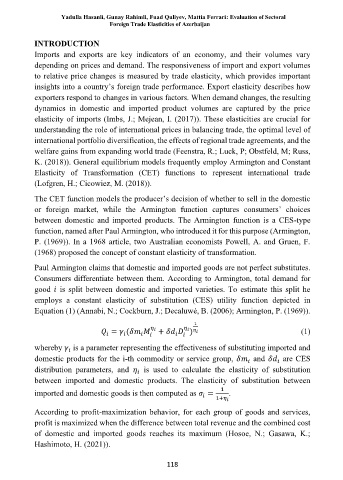
                    employs  a  constant  elasticity  of  substitution  (CES)  utility  function  depicted  in
                    Equation (1) (Annabi, N.; Cockburn, J.; Decaluwé, B. (2006); Armington, P. (1969)).

                                                                   1
                                          =    (        +         )                                (1)


                    whereby     is a parameter representing the effectiveness of substituting imported and

                    domestic products for the i-th commodity or service group,       and       are CES


                    distribution  parameters,  and       is  used  to  calculate  the  elasticity  of  substitution

                    between  imported  and  domestic  products.  The  elasticity  of  substitution  between
                                                                           1
                    imported and domestic goods is then computed as    =     .

                                                                         1+

                    According to profit-maximization behavior, for each group of goods and services,
                    profit is maximized when the difference between total revenue and the combined cost
                    of  domestic  and  imported  goods  reaches  its  maximum  (Hosoe,  N.;  Gasawa,  K.;
                    Hashimoto, H. (2021)).
                                                           118

