


Page 119 - Azerbaijan State University of Economics
P. 119
THE                 JOURNAL OF ECONOMIC SCIENCES: THEORY AND PRACTICE, V.82, # 2, 2025, pp. 117-137


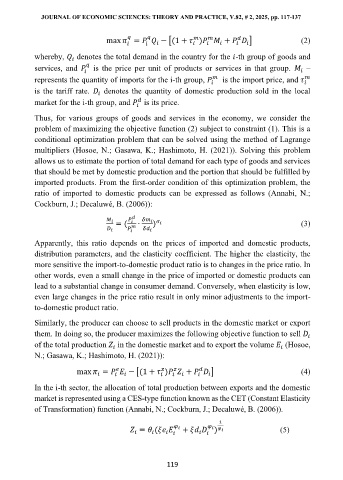
                                         max    =       − [(1 +    )      +       ]                (2)


                    whereby,     denotes the total demand in the country for the   -th group of goods and


                    services,  and       is  the price per unit of products  or services  in  that group.       –


                    represents the quantity of imports for the i-th group,      is the import price, and


                    is the tariff rate.      denotes the quantity of domestic production sold in the local


                    market for the i-th group, and     is its price.


                    Thus,  for  various  groups  of  goods  and  services  in  the  economy,  we  consider  the
                    problem of maximizing the objective function (2) subject to constraint (1). This is a
                    conditional optimization problem that can be solved using the method of Lagrange
                    multipliers (Hosoe, N.; Gasawa, K.; Hashimoto, H. (2021)). Solving this problem
                    allows us to estimate the portion of total demand for each type of goods and services
                    that should be met by domestic production and the portion that should be fulfilled by
                    imported products. From the first-order condition of this optimization problem, the
                    ratio  of  imported  to  domestic  products  can  be  expressed  as  follows  (Annabi,  N.;
                    Cockburn, J.; Decaluwé, B. (2006)):


                                            = (      ∙  )                                          (3)


                    Apparently,  this  ratio  depends  on  the  prices  of  imported  and  domestic  products,
                    distribution parameters, and the elasticity coefficient. The higher the elasticity, the
                    more sensitive the import-to-domestic product ratio is to changes in the price ratio. In
                    other words, even a small change in the price of imported or domestic products can
                    lead to a substantial change in consumer demand. Conversely, when elasticity is low,
                    even large changes in the price ratio result in only minor adjustments to the import-
                    to-domestic product ratio.

                    Similarly, the producer can choose to sell products in the domestic market or export
                    them. In doing so, the producer maximizes the following objective function to sell

                    of the total production     in the domestic market and to export the volume     (Hosoe,


                    N.; Gasawa, K.; Hashimoto, H. (2021)):


                                max    =       − [(1 +    )      +       ]                         (4)


                    In the i-th sector, the allocation of total production between exports and the domestic
                    market is represented using a CES-type function known as the CET (Constant Elasticity
                    of Transformation) function (Annabi, N.; Cockburn, J.; Decaluwé, B. (2006)).

                                                                          1

                                                                    =    (                +         )                   (5)


                                                           119

