


Page 61 - Azerbaijan State University of Economics
P. 61
THE JOURNAL OF ECONOMIC SCIENCES: THEORY AND PRACTICE, V.70,  # 2, 2013,  pp. 32-66


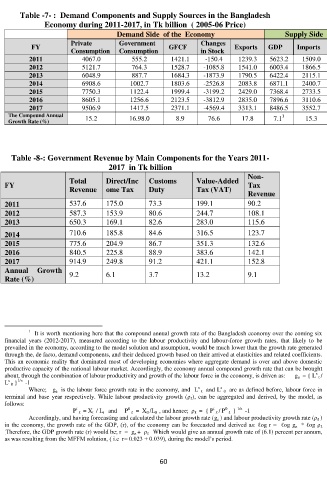
                    Table -7- :  Demand Components and Supply Sources in the Bangladesh
                           Economy during 2011-2017, in Tk billion  ( 2005-06 Price)

                                                Demand Side  of the  Economy                          Supply Side
                                   Private       Government              Changes
                       FY                                       GFCF               Exports   GDP      Imports
                                   Consumption   Consumption             in Stock
                       2011           4067.0         555.2      1421.1    -150.4    1239.3   5623.2    1509.0
                       2012           5121.7         764.3      1528.7    -1085.8   1541.0   6003.4    1866.5
                       2013           6048.9         887.7      1684.3    -1873.9   1790.5   6422.4    2115.1
                       2014           6908.6        1002.7      1803.6    -2526.8   2083.8   6871.1    2400.7
                       2015           7750.3        1122.4      1999.4    -3199.2   2429.0   7368.4    2733.5
                       2016           8605.1        1256.6      2123.5    -3812.9   2835.0   7896.6    3110.6
                       2017           9506.9        1417.5      2371.1    -4569.4   3313.1   8486.5    3552.7
                The Compound Annual    15.2         16.98.0       8.9      76.6      17.8      7.1      15.3
                                                                                                 1
                Growth Rate (%)


                 Table -8-: Government Revenue by Main Components for the Years 2011-
                                              2017  in Tk billion
                                                                                       Non-
                                  Total      Direct/Inc   Customs       Value-Added
               FY                                                                      Tax
                                  Revenue  ome Tax        Duty          Tax (VAT)
                                                                                       Revenue
               2011               537.6      175.0        73.3          199.1          90.2
               2012               587.3      153.9        80.6          244.7          108.1
               2013               650.3      169.1        82.6          283.0          115.6

               2014               710.6      185.8        84.6          316.5          123.7
               2015               775.6      204.9        86.7          351.3          132.6
               2016               840.5      225.8        88.9          383.6          142.1
               2017               914.9      249.8        91.2          421.1          152.8
               Annual  Growth
               Rate (%)           9.2        6.1          3.7           13.2           9.1


                      1   It is worth mentioning here that the compound annual growth rate of the Bangladesh economy over the coming six
               financial  years  (2012-2017),  measured  according  to  the  labour  productivity  and  labour-force  growth  rates,  that  likely  to  be
               prevailed in the economy, according to the model solution and assumption, would be much lower than the growth rate generated
               through the, de facto, demand components, and their deduced growth based on their arrived at elasticities and related coefficients.
               This an economic reality that dominated most of developing economies where aggregate demand is over and above domestic
               productive capacity of the national labour market. Accordingly, the economy annual compound growth rate that can be brought
                                                                                                           s
               about, through the combination of labour productivity and growth of the labour force in the economy, is driven as:      g e   = { L t  /
                s
               L 0  } 1/n   -1
                                                                        s
                                                                               s
                      Where;   g e   is the labour force growth rate in the economy, and  L t   and L 0   are as defined before, labour force in
               terminal and base year respectively. While labour productivity growth (ρ ℓ ), can be aggregated and derived, by the model, as
               follows:
                                     t
                                                                                0
                                                                             t
                                                    0
                                                   P ℓ   = X t   / L t    and     P ℓ   =  X 0  /L 0   , and hence;  ρ ℓ   =  { P ℓ  / P ℓ   }  1/n   -1
                      Accordingly, and having forecasting and calculated the labour growth rate (g e  ) and labour productivity growth rate (ρ ℓ  )
               in the economy, the growth rate of the GDP, (r), of the economy can be forecasted and derived as: ℓog r =  ℓog  g e   * ℓog ρ ℓ
               . Therefore, the GDP growth rate (r) would be; r  =  g e  +  ρ ℓ    Which would give an annual growth rate of (6.1) percent per annum,
               as was resulting from the MFFM solution, ( i.e  r= 0.023 + 0.039), during the model’s period.

                                                             60

