


Page 73 - Azerbaijan State University of Economics
P. 73
Murad Yusifov: Modelling the inflationary processes and forecasting:an application of ARIMA,
                                                  SARIMA models


                                       Table.2. Results of SARIMA(2,0,2)(1,0,0)x12.


                             Variable                      Coefficients     Std. error    Prob.
                             C                                 100.0933        0.278618        0
                             AR(1)                             1.012855        0.284939  0.0008
                             AR(2)                             -0.51392        0.224334  0.0261
                             SAR(12)                           0.566002        0.118397        0
                             MA(1)                             -0.77715        0.300845  0.0126
                             MA(2)                              0.54498        0.197902  0.0081


               The estimated SARIMA(1,0,1)(0,0,1)x12 model are as follows.


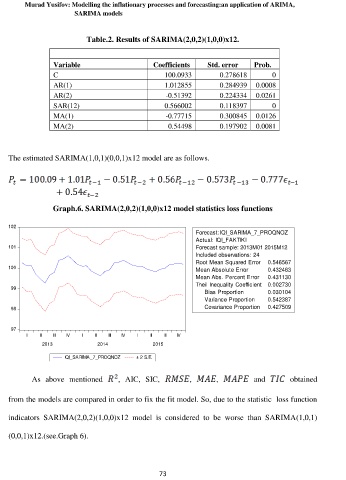
                             Graph.6. SARIMA(2,0,2)(1,0,0)x12 model statistics loss functions


               102
                                                                        Forecast: IQI_SARIMA_7_PROQNOZ
                                                                        Actual: IQI_FAKTIKI
               101                                                      Forecast sample: 2013M01 2015M12
                                                                        Included observations: 24
                                                                        Root Mean Squared Error  0.546567
               100                                                      Mean Absolute Error        0.432463
                                                                        Mean Abs. Percent Error   0.431130
                                                                        Theil Inequality Coefficient   0.002730
                99
                                                                             Bias Proportion           0.030104
                                                                             Variance Proportion    0.542387
                98                                                           Covariance Proportion   0.427509


                97
                     I   II  III  IV  I   II  III  IV  I  II  III  IV
                          2013            2014             2015

                                IQI_SARIMA_7_PROQNOZ  ± 2 S.E.

                      As  above  mentioned       ,  AIC,  SIC,        ,       ,           and        obtained


               from the models are compared in order to fix the fit model. So, due to the statistic  loss function

               indicators  SARIMA(2,0,2)(1,0,0)x12  model  is  considered  to  be  worse  than  SARIMA(1,0,1)


               (0,0,1)x12.(see.Graph 6).


                                                             73

