


Page 27 - Azerbaijan State University of Economics
P. 27
Hashim Al-Ali: Towards a realistic medium term macroeconomic and fiscal framework and
                                                   outlook for the Somali national economy (2017- 2019)


               usually by external donors, and what is shown in the budget, if any, is merely the depreciation of
               some of the existing capital stocks. The other side of the government accounts, is the revenues
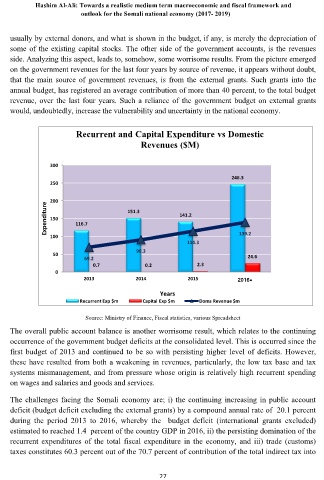
               side. Analyzing this aspect, leads to, somehow, some worrisome results. From the picture emerged
               on the government revenues for the last four years by source of revenue, it appears without doubt,
               that the main source of government revenues, is from the external grants. Such grants into the
               annual budget, has registered an average contribution of more than 40 percent, to the total budget
               revenue,  over  the  last  four  years.  Such  a  reliance  of  the  government  budget  on  external  grants
               would, undoubtedly, increase the vulnerability and uncertainty in the national economy.


                                    Recurrent and Capital Expenditure vs Domestic


                                	               	      Revenues ($M)


               	            300
               	                	               	            	        	         	  246.3
               	            250

               	            200

               	                	               	  151.3     	     141.2
               	          Expenditure  150  	  116.7

               	 	          100  	 	            	    	       	 	      	 	       	 	  139.2
                                                                      114.3
               	                                	     90.3
                            50                                                          24.6
               	                	     69.2
                                         0.7             0.2             2.3
                             0        2013            2014            2015
                                                                                     2016*
                                                             Years
                                     Recurrent	Exp	$m   Capital	Exp	$m   Doms	Revenue	$m


                                      Source: Ministry of Finance, Fiscal statistics, various Spreadsheet

               The overall public account balance is another worrisome result, which relates to the continuing
               occurrence of the government budget deficits at the consolidated level. This is occurred since the
               first budget of 2013 and continued to be so with persisting higher level of deficits. However,
               these have resulted from both a weakening in revenues, particularly, the low tax base and tax
               systems mismanagement, and from pressure whose origin is relatively high recurrent spending
               on wages and salaries and goods and services.

               The challenges facing the Somali economy are; i) the continuing increasing in public account
               deficit (budget deficit excluding the external grants) by a compound annual rate of  20.1 percent
               during  the  period  2013  to  2016,  whereby  the    budget  deficit  (international  grants  excluded)
               estimated to reached 1.4  percent of the country GDP in 2016, ii) the persisting domination of the
               recurrent expenditures of the total fiscal expenditure in the economy, and iii) trade (customs)
               taxes constitutes 60.3 percent out of the 70.7 percent of contribution of the total indirect tax into


               	                                             27

