


Page 30 - Azerbaijan State University of Economics
P. 30
THE JOURNAL OF ECONOMIC SCIENCES: THEORY AND PRACTICE, V.74, # 2, 2017, pp. 4-31


               these  three  revenue  components.  With  this  existing  structure  in  mind,  we  have  attempted  to
               estimate these components, utilizing their functional correlations with, amongst others; income,
               GDP and trade volume that have been forecasted and driven for the economy for the period 2017-
               2019 and presented within the plan macroeconomic framework derived earlier and stated above in
               this  paper.  These  estimates  also  based  on  the  assumptions  that  there  would  be  some  concerted
               efforts by the government to carry out real improvement in the tax regime, including issuance of
               the new tax-law, increasing tax base and enhancing tax collection and administrative process and
               capabilities. However, most importantly these revenue estimates are also based on the fact that
               assumption  of  the  planned  and  incurring  higher  level  of  investment,  at  different  sectors  and
               activities  level,  in  Somali  economy,  during  the  SNDP  period,  would  be  realized  and  achieved,
               particularly, the planned investment in the infrastructure and services sector. This also would be
               complemented and associated with increased level of imports particularly those of machineries and
               equipment into the national economy, which needed to support planned investment.

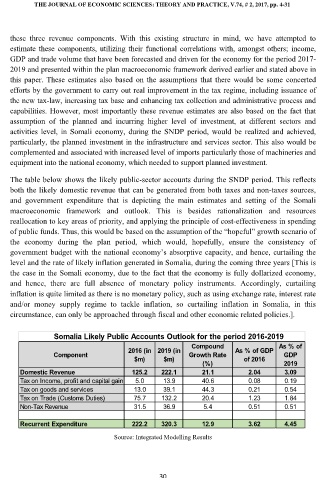
               The table below shows the likely public-sector accounts during the SNDP period. This reflects
               both the likely domestic revenue that can be generated from both taxes and non-taxes sources,
               and  government  expenditure  that  is  depicting  the  main  estimates  and  setting  of  the  Somali
               macroeconomic  framework  and  outlook.  This  is  besides  rationalization  and  resources
               reallocation to key areas of priority, and applying the principle of cost-effectiveness in spending
               of public funds. Thus, this would be based on the assumption of the “hopeful” growth scenario of
               the  economy  during  the  plan  period,  which  would,  hopefully,  ensure  the  consistency  of
               government budget with the national economy’s absorptive capacity, and hence, curtailing the
               level and the rate of likely inflation generated in Somalia, during the coming three years [This is
               the case in the Somali economy, due to the fact that the economy is fully dollarized economy,
               and  hence,  there  are  full  absence  of  monetary  policy  instruments.  Accordingly,  curtailing
               inflation is quite limited as there is no monetary policy, such as using exchange rate, interest rate
               and/or  money  supply  regime  to  tackle  inflation,  so  curtailing  inflation  in  Somalia,  in  this
               circumstance, can only be approached through fiscal and other economic related policies.].

                                 Somalia Likely Public Accounts Outlook for the period 2016-2019
                                                                       Compound                   As % of
                                                    2016 (in  2019 (in              As % of GDP
                             Component                                Growth Rate                  GDP
                                                     $m)      $m)                      of 2016
                                                                          (%)                      2019
                  Domestic Revenue                   125.2    222.1       21.1          2.04       3.09
                  Tax on Income, profit and capital gain   5.0  13.9      40.6          0.08       0.19
                  Tax on goods and services          13.0     39.1        44.3          0.21       0.54
                  Tax on Trade (Customs Duties)      75.7     132.2       20.4          1.23       1.84
                  Non-Tax Revenue                    31.5     36.9         5.4          0.51       0.51

                  Recurrent Expenditure              222.2    320.3       12.9          3.62       4.45

                                               Source: Integrated Modelling Results


               	                                             30

