


Page 12 - Azerbaijan State University of Economics
P. 12
THE JOURNAL OF ECONOMIC SCIENCES: THEORY AND PRACTICE, V.77, # 2, 2020, pp. 4-39


                    number  from  the  study  population  and  its  number  reached  (308)  employees  and
                    employees  of  the  Authority.  Aqaba  Special  Economic  Zone.  The  questionnaires
                    were distributed over all the sample items, so (265) questionnaires were retrieved
                    (86%) of the study sample size, and (19) questionnaires were excluded because they
                    were not suitable for statistical analysis, and thus the number of questionnaires valid
                    for  analysis  became  (246)  questionnaires,  forming  (80%))  Of  the  study  sample,
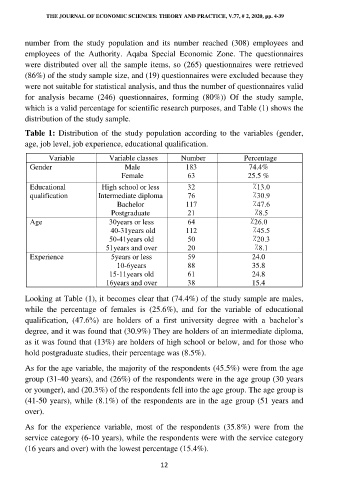
                    which is a valid percentage for scientific research purposes, and Table (1) shows the
                    distribution of the study sample.
                    Table  1:  Distribution  of  the  study  population  according  to  the  variables  (gender,
                    age, job level, job experience, educational qualification.

                           Variable         Variable classes     Number             Percentage
                     Gender                      Male              183               74.4%
                                                Female             63                25.5 %
                     Educational          High school or less      32                  ٪ 13.0
                     qualification       Intermediate diploma      76                  ٪ 30.9
                                               Bachelor            117                 ٪ 47.6
                                             Postgraduate          21                  ٪ 8.5
                     Age                      30years or less      64                 ٪ 26.0
                                             40 - 31years old      112                 ٪ 45.5
                                            50 - 41years old       50                  ٪ 20.3
                                           51years and over        20                  ٪ 8.1
                     Experience              5   years or less     59                 24.0
                                               10  6 - years       88                 35.8
                                            15 - 11years old       61                 24.8
                                           16years and over        38                 15.4

                    Looking at Table (1), it becomes clear that (74.4%) of the study sample are males,
                    while  the  percentage  of  females  is  (25.6%),  and  for  the  variable  of  educational
                    qualification,  (47.6%)  are  holders  of  a  first  university  degree  with  a  bachelor’s
                    degree, and it was found that (30.9%) They are holders of an intermediate diploma,
                    as it was found that (13%) are holders of high school or below, and for those who
                    hold postgraduate studies, their percentage was (8.5%).

                    As for the age variable, the majority of the respondents (45.5%) were from the age
                    group (31-40 years), and (26%) of the respondents were in the age group (30 years
                    or younger), and (20.3%) of the respondents fell into the age group. The age group is
                    (41-50 years), while (8.1%) of the respondents are in the age group (51 years and
                    over).

                    As  for  the  experience  variable,  most  of  the  respondents  (35.8%)  were  from  the
                    service category (6-10 years), while the respondents were with the service category
                    (16 years and over) with the lowest percentage (15.4%).

                                                           12

