


Page 13 - Azerbaijan State University of Economics
P. 13
Maddallah basheer aboud Al: The Impact of Transformatıonal Leadershıp on Strategıc Agılıty an Empırıcal
                                             Study at The Aqaba Specıal Economıc Zone Authorıty


                    STUDY TOOL:
                    The questionnaire for the study was developed based on the theoretical framework
                    and previous studies on the topic, and the questionnaire consisted of three parts:
                    The  first  part:  It  includes  information  expressing  the  characteristics  of  the  study
                    sample,  according  to  demographic  variables  (gender,  age,  job  experience,
                    educational qualification).

                    Part  Two:  This  part  includes  paragraphs  covering  the  independent  study  variable
                    (transformational leadership) that were used in building this part of the questionnaire
                    on the dimensions of transformational leadership through the study (Al-Balushi, et
                    al., 2019; Al-Shukirat and Al-Jazi, 2019; Al-Jarida, 2018; Al-Jarida, 2018. ; Kuo and
                    Lee, 2019) and the necessary adjustments were made to it to suit the objectives of
                    the study, and these dimensions are: inspiring motivation, represented by paragraphs
                    (1-6),  inspiring  motivation  and  represented  by  paragraphs  (7-9),  creative
                    encouragement (10-13), individual attention. It is represented by paragraphs (14-16).
                    The third part: It includes paragraphs aimed at strategic agility, as the paragraphs of
                    this variable were guided by studying each of (Abdel Aal, 2019; Al-Mousawi, 2018;
                    Karumi,  2018;  Al  2019,  Nejatian)  and  it  includes  three  sub-dimensions  for
                    measuring  strategic  agility,  represented  in:  (the  dimension  Strategic  sensitivity,
                    organizational capabilities, strategic response) Likert scale was used to measure the
                    responses  of  the  respondents,  which  calculates  the  weight  of  its  paragraphs  as
                    follows:  (completely  agree  and  represent  5  degrees),  and  (agree  and  represent  4
                    degrees), and (agree, agree. With a medium degree, which represents 3 degrees), (I
                    do not agree, represents 2 degrees) and (I do not agree at all, which represents 1).
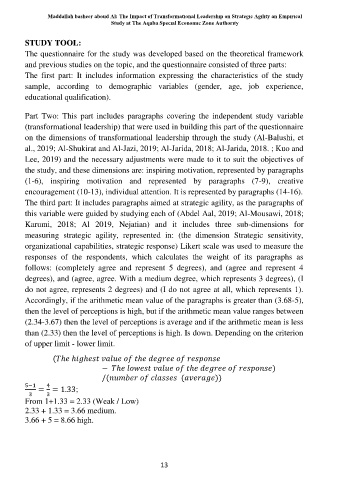
                    Accordingly, if the arithmetic mean value of the paragraphs is greater than (3.68-5),
                    then the level of perceptions is high, but if the arithmetic mean value ranges between
                    (2.34-3.67) then the level of perceptions is average and if the arithmetic mean is less
                    than (2.33) then the level of perceptions is high. Is down. Depending on the criterion
                    of upper limit - lower limit.

                            (  ℎ   ℎ    ℎ                         ℎ
                                          −    ℎ                                  ℎ                                     )
                                          /(                                  (              ))
                          4
                    5−1  = = 1.33;
                     3    3
                    From 1+1.33 = 2.33 (Weak / Low)
                    2.33 + 1.33 = 3.66 medium.
                    3.66 + 5 = 8.66 high.


                                                           13

