


Page 100 - Azerbaijan State University of Economics
P. 100
Yang Zhifang, Zhang Jieqian, Rudnák Ildikó: China-Hungary Trade Relations
                                                                                                     Under The Belt And Road Initiative


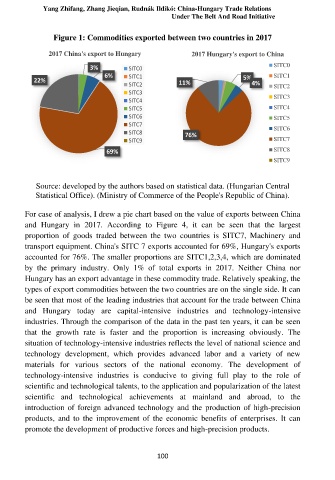
                            Figure 1: Commodities exported between two countries in 2017

                           2017 China's export to Hungary            2017 Hungary's export to China
                                                                                             SITC0
                                       3%         SITC0
                                           6%     SITC1                             5%       SITC1
                      22%
                                                  SITC2          11%                   4%    SITC2
                                                  SITC3                                      SITC3
                                                  SITC4
                                                  SITC5                                      SITC4
                                                  SITC6                                      SITC5
                                                  SITC7                                      SITC6
                                                  SITC8            76%
                                                  SITC9                                      SITC7
                                            69%                                              SITC8
                                                                                             SITC9


                       Source: developed by the authors based on statistical data. (Hungarian Central
                       Statistical Office). (Ministry of Commerce of the People's Republic of China).

                    For case of analysis, I drew a pie chart based on the value of exports between China
                    and  Hungary  in  2017.  According  to  Figure  4,  it  can  be  seen  that  the  largest
                    proportion  of  goods  traded  between  the  two  countries  is  SITC7,  Machinery  and
                    transport equipment. China's SITC 7 exports accounted for 69%, Hungary's exports
                    accounted for 76%. The smaller proportions are SITC1,2,3,4, which are dominated
                    by  the  primary  industry.  Only  1%  of  total  exports  in  2017.  Neither  China  nor
                    Hungary has an export advantage in these commodity trade. Relatively speaking, the
                    types of export commodities between the two countries are on the single side. It can
                    be seen that most of the leading industries that account for the trade between China
                    and  Hungary  today  are  capital-intensive  industries  and  technology-intensive
                    industries. Through the comparison of the data in the past ten years, it can be seen
                    that  the  growth  rate  is  faster  and  the  proportion  is  increasing  obviously.  The
                    situation of technology-intensive industries reflects the level of national science and
                    technology  development,  which  provides  advanced  labor  and  a  variety  of  new
                    materials  for  various  sectors  of  the  national  economy.  The  development  of
                    technology-intensive  industries  is  conducive  to  giving  full  play  to  the  role  of
                    scientific and technological talents, to the application and popularization of the latest
                    scientific  and  technological  achievements  at  mainland  and  abroad,  to  the
                    introduction of foreign  advanced technology  and the production of high-precision
                    products,  and  to  the  improvement  of  the  economic  benefits  of  enterprises.  It  can
                    promote the development of productive forces and high-precision products.


                                                           100

