


Page 98 - Azerbaijan State University of Economics
P. 98
Yang Zhifang, Zhang Jieqian, Rudnák Ildikó: China-Hungary Trade Relations
                                                                                                      Under The Belt And Road Initiative

                                      Table 2: Main data of EU28 trade. Unit :Trillion

                                         2011      2013      2015      2017      2019      2020

                          IMPORT          2.41     2.24      1.92      2.10      2.30      1.96
                          EXPORT          2.18     2.31      1.98      2.12      2.28      2.19

                            GDP          18.35     18.03     16.42     17.28     15.63     15.20

                        IMPORT/GDP      13.15%    12.44%    11.68%    12.13%    14.72%    12.89%
                        EXPORT/GDP  11.87%        12.82%    12.08%    12.28%    14.56%    14.40%

                           RATIO        25.02%    25.26%    23.77%    24.41%    29.28%    27.9%

                      Source: developed by the authors based on statistical data. (UN comtrade database).

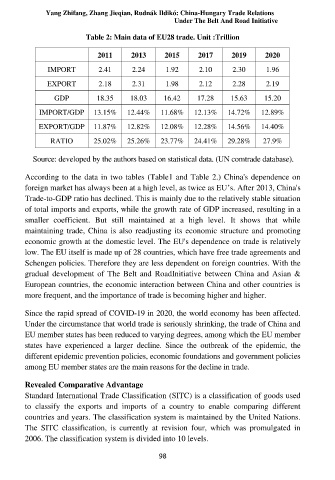
                    According to the data in two tables (Table1 and Table 2.) China's dependence on
                    foreign market has always been at a high level, as twice as EU’s. After 2013, China's
                    Trade-to-GDP ratio has declined. This is mainly due to the relatively stable situation
                    of total imports and exports, while the growth rate of GDP increased, resulting in a
                    smaller  coefficient.  But  still  maintained  at  a  high  level.  It  shows  that  while
                    maintaining trade, China is also readjusting its economic structure and promoting
                    economic growth at the domestic level. The EU's dependence on trade is relatively
                    low. The EU itself is made up of 28 countries, which have free trade agreements and
                    Schengen policies. Therefore they are less dependent on foreign countries. With the
                    gradual  development  of  The Belt and RoadInitiative between China and Asian &
                    European countries, the economic interaction between China and other countries is
                    more frequent, and the importance of trade is becoming higher and higher.

                    Since the rapid spread of COVID-19 in 2020, the world economy has been affected.
                    Under the circumstance that world trade is seriously shrinking, the trade of China and
                    EU member states has been reduced to varying degrees, among which the EU member
                    states  have  experienced  a  larger  decline.  Since  the  outbreak  of  the  epidemic,  the
                    different epidemic prevention policies, economic foundations and government policies
                    among EU member states are the main reasons for the decline in trade.

                    Revealed Comparative Advantage
                    Standard International Trade Classification (SITC) is a classification of goods used
                    to  classify  the  exports  and  imports  of  a  country  to  enable  comparing  different
                    countries and years. The classification system is maintained by the United Nations.
                    The  SITC  classification,  is  currently  at  revision  four,  which  was  promulgated  in
                    2006. The classification system is divided into 10 levels.

                                                           98

